

Key Takeaways
Most Frank Stella prints sold at auction over the past five years have achieved between approximately £2,750 and £9,800 at hammer. Yet these figures conceal a market made up of distinct series, periods and techniques, each with its own pricing structure. A sheet from the 1967 Black Series can sell for under £3,000, while Double Gray Scramble (1973) has recently traded between £52,000 and £98,000.
Frank Stella (1936–2024) is best known for his paintings, but printmaking remained central to his practice for almost four decades. Beginning with geometric lithographs in the late 1960s, he went on to produce some of the most technically ambitious prints of the twentieth century, working closely with master printer Kenneth Tyler. His experimentation with colour, scale, layered techniques and sculptural relief created an unusually diverse body of editioned work, and one in which value is closely tied to the characteristics of individual series.
How Much Is a Frank Stella Print Worth?
The value of a Stella print depends largely on its series, period, edition size and condition. In the 12 months to October 2026, 143 Stella prints sold at auction with a recorded price, at a median hammer price of £6,500. Just over a third sold for under £5,000, and just under a third achieved £10,000 or more.
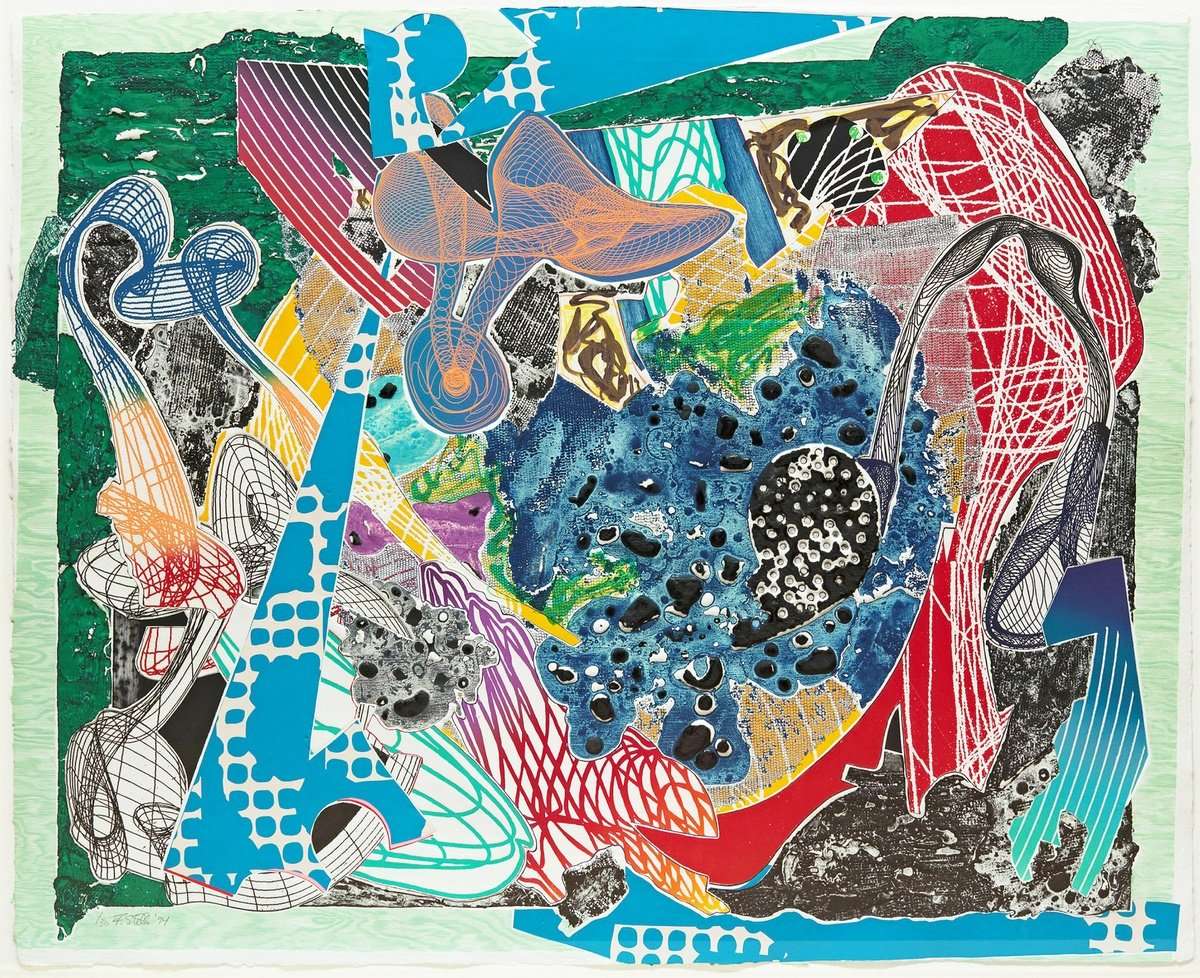
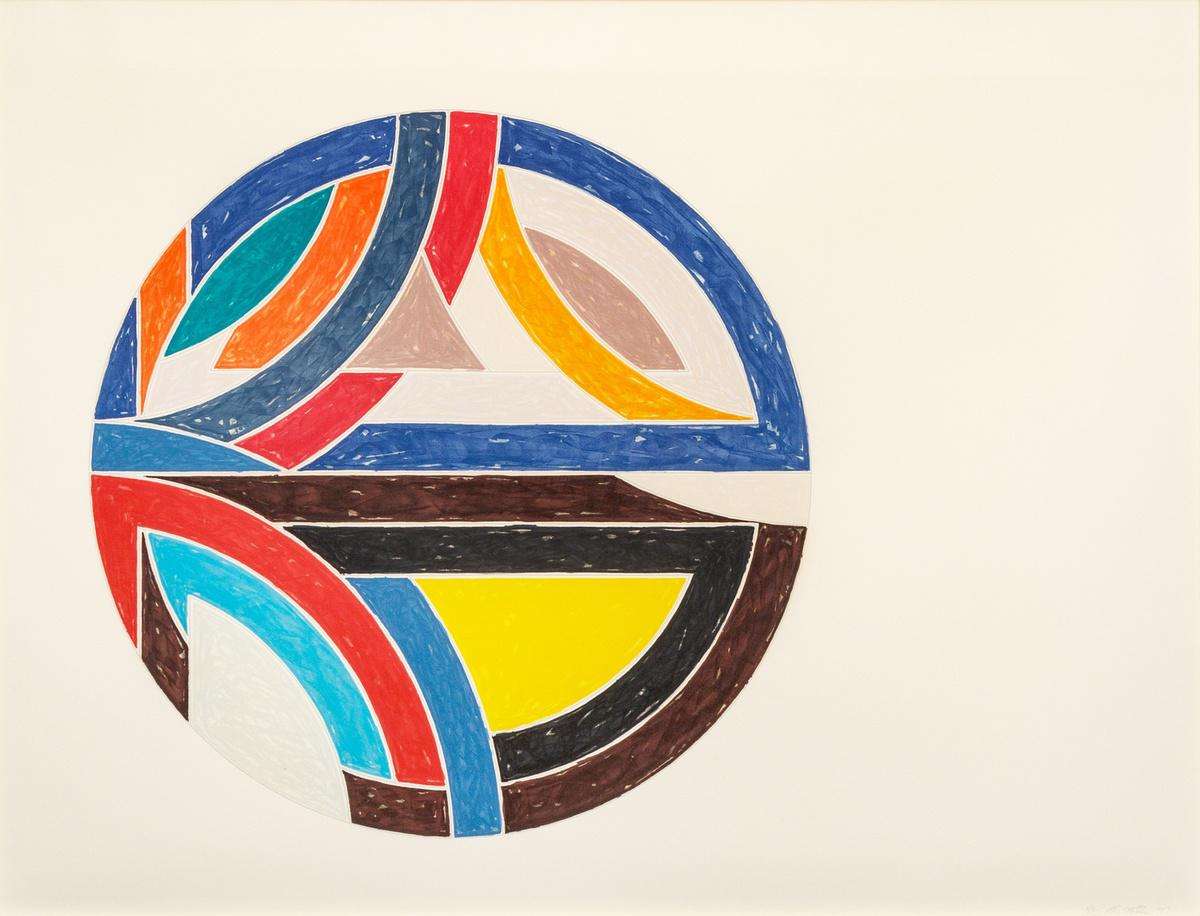
The highest prices are concentrated in Stella’s experimental prints of the 1970s and 1980s, when his practice moved from flat geometric compositions towards layered, sculptural forms. The Circuits series (1982–84) was produced in editions of around 30. Since 2021 it has achieved a median hammer price of approximately £15,000, and Pergusa Three reached £64,390. The Newfoundland prints (1971) and the Had Gadya series (1982–84) come next, with medians of approximately £11,000–£12,000. Polar Co-ordinates (1980), the V Series (1968) and Shards (1982) occupy the middle market. The earlier Black Series and Eccentric Polygons prints often sell below £3,000.
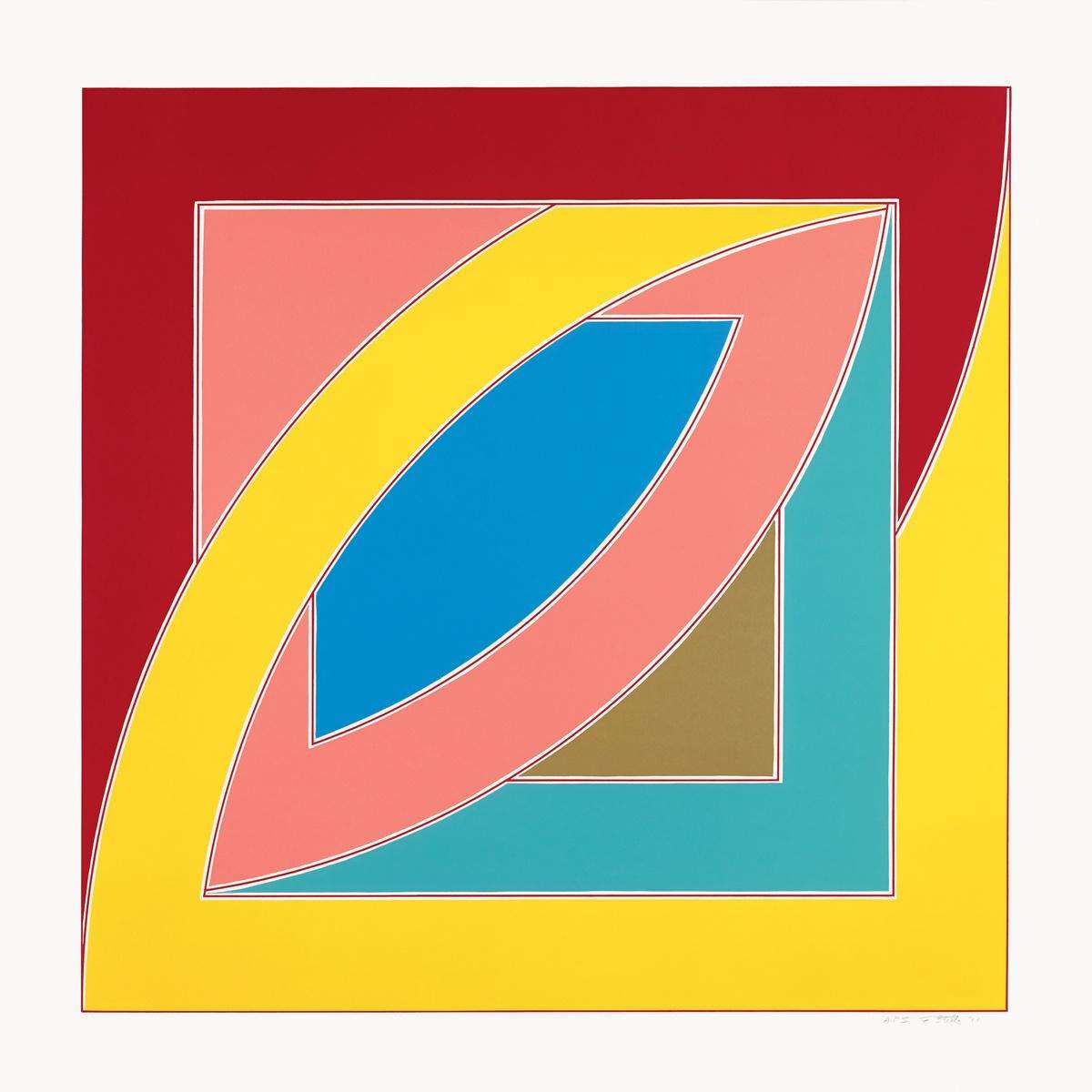
Complete sets form a distinct, higher-value category. In April 2023, a complete four-part River of Ponds set from the Newfoundland group achieved £127,590 at hammer at Christie’s New York. For sellers, comparing a print with recent sales of the same work is a more reliable guide than any market average.
Frank Stella Print Auction Records
The highest recorded auction price for a Stella print is held by The Fountain (1992), which achieved $375,000 including fees at Christie's New York in October 2019. Spanning more than seven metres across three sheets of handmade paper, the work combines various printing techniques. Published by Tyler Graphics, it is among the most ambitious and rarely available works in Stella's printmaking practice.
Top Prices Paid for Frank Stella Prints
| Work | Auction | Price |
|---|---|---|
| The Fountain (1992) | Christie’s New York, Oct 2019 | £290,360 ($375,000) |
| Double Gray Scramble (1973) | Christie’s New York, Nov 2018 | £252,774 ($324,500) |
| Sinjerli Variation Squared with Colored Grounds (1981), set of six | Christie’s New York (online), Oct 2026 | £229,254 ($307,200) |
| River of Ponds I–IV (1971), set of four | Christie’s New York, Apr 2023 | £162,040 ($201,600) |
| Double Gray Scramble (1973) | Sotheby’s New York, Oct 2026 | £125,784 ($166,400) |
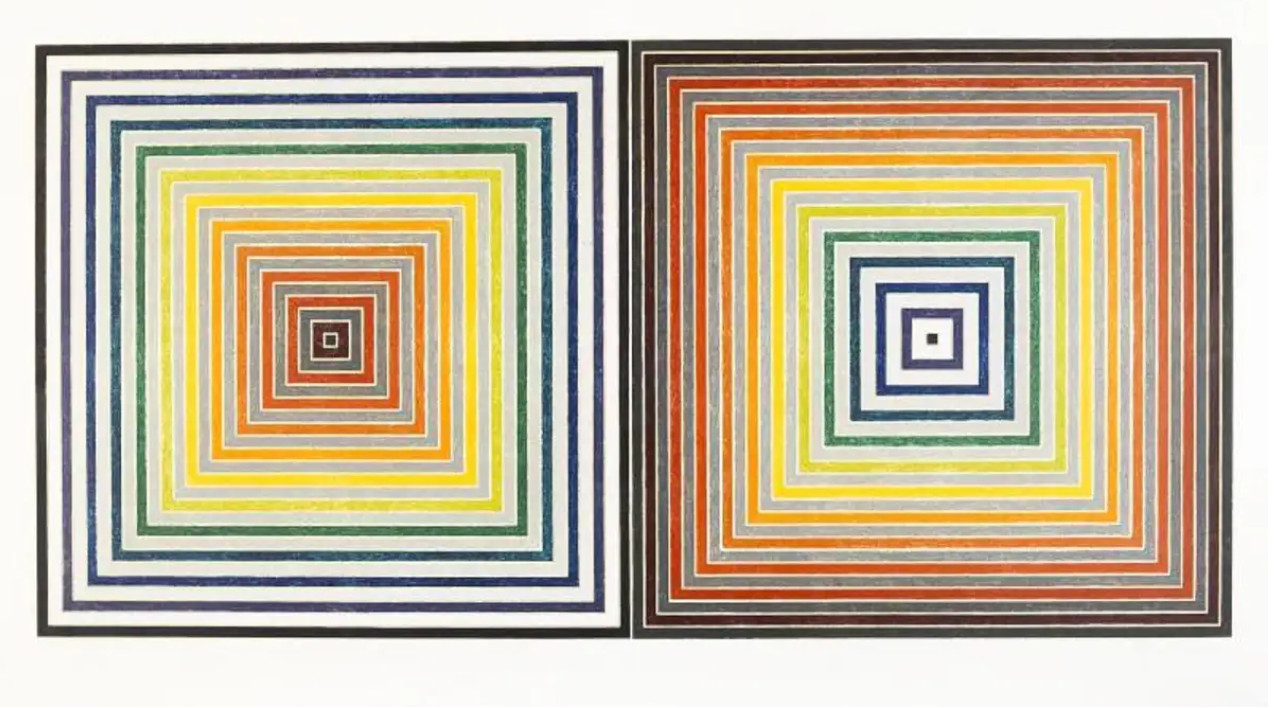
Double Gray Scramble: A Benchmark for Frank Stella Print Values
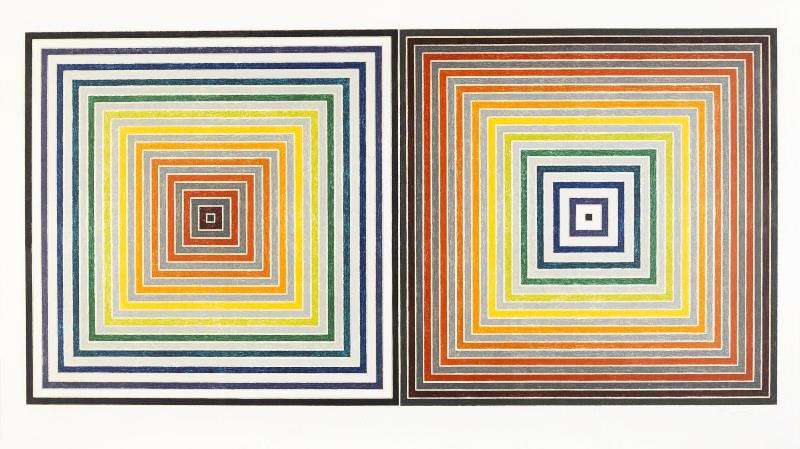
Among Stella's individual prints, Double Gray Scramble (1973) provides one of the clearest examples of sustained demand at the upper end of the market.
The concentric-square screenprint has appeared at auction eight times since 2021, achieving hammer prices between £52,029 at Phillips in 2025 and £98,421 at Sotheby's in October 2026.
The October 2026 result was its strongest since the £199,035 hammer record established in 2018. An artist's proof also sold for £71,529 at Bonhams in 2024, within the recent trading range of the numbered edition.
Unlike works that rarely appear publicly, Double Gray Scramble benefits from a relatively consistent record of comparable sales. For owners, this provides a clearer basis for valuation, although condition, provenance and the availability of competing impressions remain important.
What Does the 2026 Frank Stella Estate Sale Mean for Sellers?
One of the most significant recent moments in Stella’s print market was Christie’s October 2026 online sale, Graphic Alchemist: Works from the Estate of Frank Stella. Of 65 lots, 61 sold for a combined $1,793,920 including fees, against presale estimates of $755,000–$1,086,000, and more than half exceeded their high estimates.
The strongest results came from rare proofs that Stella kept himself. An artist proof complete set of Sinjerli Variation Squared with Colored Grounds achieved $307,200 against an estimate of $60,000–$80,000. The Fossil Whale (Dome) (AP) from the Moby Dick Domes reached $140,800 against $15,000–$20,000.
These results show the premium buyers pay for rarity and provenance. They don’t mean prices have risen across the whole Stella market, but they do give sellers of comparable works useful new reference points.
What Determines the Value of a Frank Stella Print?
Edition Size and Rarity
Smaller editions tend to achieve higher prices, though not automatically. Since 2021, prints from editions of 60 or fewer have achieved median hammer prices of approximately £9,600–£9,900, compared with around £3,500 for larger editions. The gap partly reflects which prints fall into each group. The Circuits prints were issued in editions of around 30, while earlier lithographs often ran far larger. Rabat, for example, was published in an edition of 500.
Artist’s Proofs and Trial Proofs
The premium for proofs varies considerably. Double Gray Scramble (AP) sold in 2024 within the range of the standard edition. By contrast, a trial proof of The Pacific achieved £48,466 at Sotheby’s in 2023, the highest of four recorded results for the title. Sellers should establish whether a print is numbered, an AP, a TP, a printer’s proof (PP) or a particular state, as each can be valued differently.
Condition and Provenance
Stella’s prints combine many materials and techniques, so condition matters. Fading, discolouration, surface damage or deterioration of relief elements can all reduce value. Provenance traced to the original publisher, a recognised gallery or the artist’s own collection adds appeal. The estate sale results, however, reflect exceptional circumstances rather than standard benchmarks.
How to Authenticate a Frank Stella Print
Authenticating a Stella print begins with identifying the work in the relevant catalogue raisonné and confirming that the physical impression corresponds with its documented specifications.
The principal reference is the scholarship of Richard H. Axsom, who catalogued Stella's prints in two major publications: The Prints of Frank Stella: A Catalogue Raisonné, 1967–1982 (1983) and Frank Stella Prints: A Catalogue Raisonné (2016), which documents more than 300 editioned prints. Because the two catalogues cover different periods and may use different references, it is important to identify which publication an Axsom number comes from.
A specialist will compare the details with the physical work to the catalogue reference, examining the signature, numbering, inscriptions and any publisher or workshop blindstamps. Stella's prints were produced with leading workshops including Gemini G.E.L. and Tyler Graphics, whose documentation can provide important supporting evidence.
Trial proofs and colour variations require particular attention because legitimate impressions may differ from the standard edition. Equally, an unexpected signature, inconsistent dimensions or missing workshop marks may require further investigation.
Certificates of authenticity can form part of a work's documentation, but should not replace examination of the print itself, its catalogue reference and its provenance.
For sellers, clear photographs of the front and reverse, together with details of inscriptions, numbering and any blindstamps, provide a useful starting point for authentication and valuation.
How Does Condition Affect the Value of a Frank Stella Print?
Many of Stella's works were produced on handmade or hand-coloured papers, sometimes developed specifically for individual projects. These materials can be vulnerable to discolouration, foxing, acid burn and other forms of deterioration. His saturated colour fields may also show visible fading following prolonged exposure to light.
The sculptural and relief-based prints require additional care. Works from series such as Circuits, Moby Dick and Imaginary Places can contain embossed, raised or layered passages that are susceptible to crushing, cracking, flaking or separation. Metallic inks and powders may also deteriorate over time.
Owners should avoid attempting to remove fragile or valuable prints from their frames themselves. A qualified paper conservator or experienced professional framer can assess the work safely where necessary.
Appropriate storage and framing can help preserve value. Acid-free materials, protection from direct sunlight, stable humidity and suitable glazing are particularly important, while shaped or relief-based works may require specialist framing.
When Is the Best Time to Sell a Frank Stella Print?
The best time to sell a Stella print depends on the work itself, its recent auction history and the availability of comparable impressions. For several of Stella's sought-after series, the second half of 2026 has provided useful new pricing benchmarks.
Double Gray Scramble achieved its strongest auction result in eight years in October, while the Christie's estate sale established notable results for works from Sinjerli, Moby Dick, Imaginary Places and Polar Co-ordinates.
These sales provide fresh evidence of buyer interest in particular categories of Stella's printmaking. They may also help specialists position comparable works more accurately.
However, a strong result for one impression does not necessarily translate into a higher valuation for every work in the same series. Edition type, provenance, condition and the number of similar works currently available all influence the appropriate selling strategy.
For prints with limited recent auction history, specialist valuation becomes especially important. The absence of recent comparable sales does not necessarily indicate weak demand, but it can make pricing more complex.
For owners considering selling, the priority should be to establish a realistic value for their specific work and identify the route most likely to reach the relevant collectors.
Should I Sell My Frank Stella Print at Auction or Private Sale?
Choosing where to sell a Stella print depends on the work's value, rarity and current collector demand. Auction houses provide access to an international audience and the potential for competitive bidding, particularly for rare works with strong provenance. However, auction sales also involve seller commissions, additional fees and the risk of a work failing to meet its reserve. An unsold result also becomes part of the public auction record, potentially influencing future valuations.
Private sales offer greater control over pricing, timing and discretion. Rather than relying on bidding on a particular day, works can be offered directly to collectors with an established interest in Stella's prints. This can be particularly valuable for works with a clear market history, where recent comparable sales provide a reliable basis for pricing.
For Stella, whose print market ranges from relatively accessible early lithographs to rare experimental editions and complete portfolios, the appropriate selling strategy should reflect the individual work. A specialist can assess recent sales, current demand and available supply to determine whether auction or private sale offers the strongest opportunity.
How to Sell a Frank Stella Print with MyArtBroker
MyArtBroker specialises in the private sale of modern and contemporary prints and editions, connecting sellers with an international network of collectors actively seeking specific works.
Our specialists provide complimentary valuations informed by public auction results, private market activity and the individual characteristics of each print. Through our Trading Floor and print market database, we can identify current collector interest and advise on pricing before a work is offered for sale.
Sellers pay 0% commission, with our fees paid by buyers. Our team manages the sales process, from valuation and negotiation through to payment, insurance and shipping.
We also partner with auction houses. For some prints, our specialists may judge that auction is the better route to market, and when that’s the case, we’ll tell you upfront. Our recommendation is always based on our market data and on what we believe will achieve the best outcome for your work.
If you’re considering selling a Stella print, request a free valuation or speak with our specialists about the most appropriate route to market.