

Key Takeaways
Frank Stella (1936–2024) made prints for almost four decades, and his editioned work is among the most technically ambitious of the twentieth century. For buyers, that range is both the appeal and the challenge. A sheet from the 1967 Black Series I can be bought for under £3,000, while the strongest impressions of Double Gray Scramble (1973) have made more than £250,000 with fees. Between the two sits a market organised by series, edition size and technique rather than by the artist’s name alone. This guide sets out what Stella prints cost in 2026, which series to look for, how to authenticate and assess condition, and where to buy.
How Much Is a Frank Stella Print Worth?
Most Stella prints sell at auction for under £10,000. In 2026, the median hammer price was £6,500, just over a third of prints sold for under £5,000, and just under a third achieved £10,000 or more. That makes Stella one of the more accessible blue chip names of his generation, but the median hides a wide spread between series.
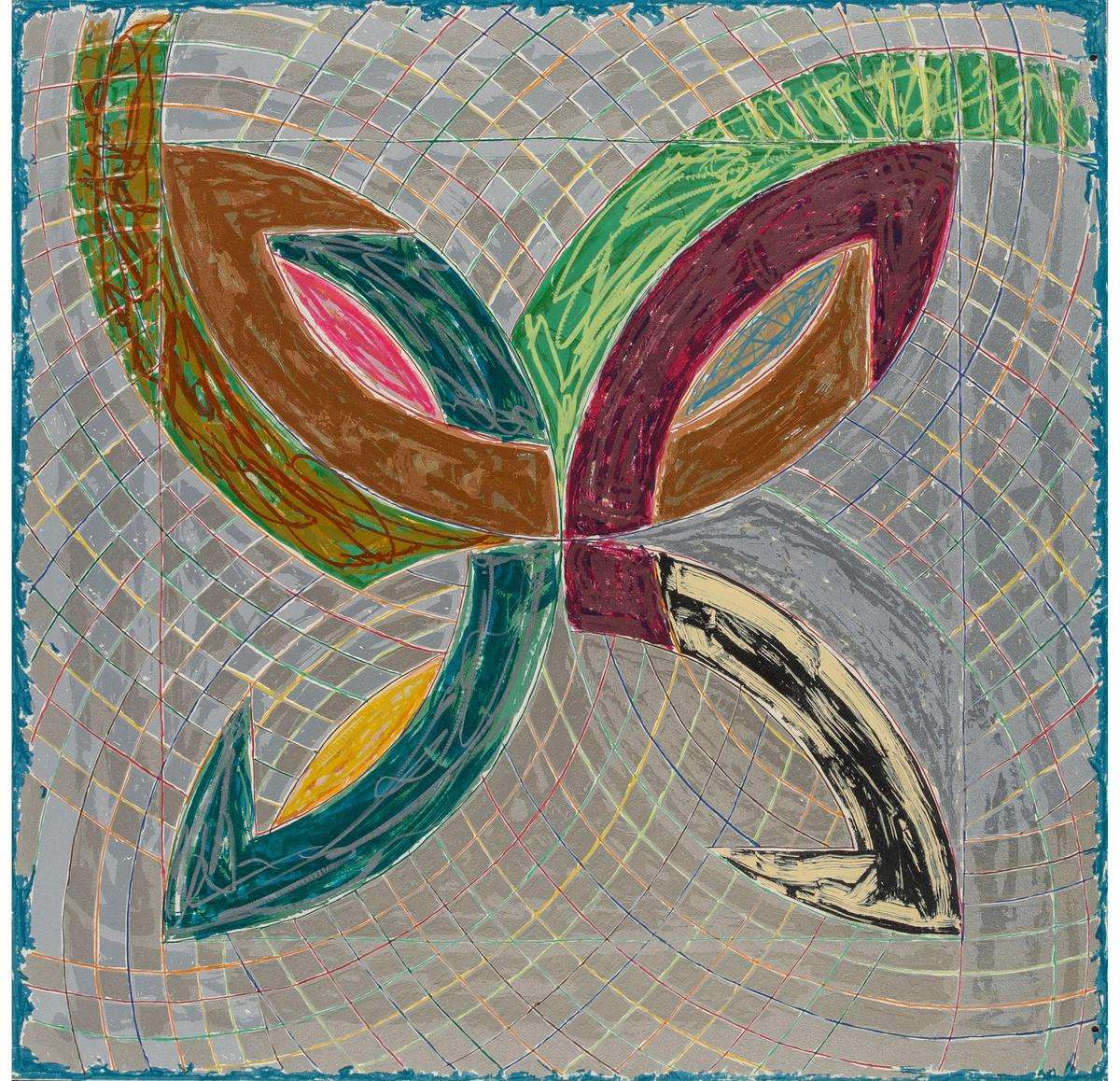
The entry point lies in the earlier lithographs. Prints from the Black Series and Eccentric Polygons often sell for under £3,000, and Rabat (1964), published in an edition of 500, carries a MyArtBroker market value of £1,100–£1,650. Polar Co-ordinates (1980), the V Series (1968) and Shards (1982) occupy the middle market. Over the past five years, the Newfoundland prints (1971) and the Had Gadya series (1982–84) have achieved median hammer prices of approximately £11,000–£12,000. The Circuits series (1982–84), issued in editions of around 30, has achieved approximately £15,000.
Above that sits a small group of benchmark works and complete sets. Double Gray Scramble currently carries a market value of £90,000–£130,000, complete portfolios from the Newfoundland and Sinjerli groups have exceeded £150,000 with fees, and the auction record for a Stella print stands at $375,000 (£290,360) with fees. Edition size explains part of the hierarchy: over the past five years, prints from editions of 60 or fewer have achieved median hammer prices of roughly £9,600–£9,900, against around £3,500 for larger editions.
Why Collect Frank Stella Prints?
Stella came to prominence in the late 1950s with his Black Paintings, whose regular stripes became a founding statement of Minimalism. Over the following decades he moved in the opposite direction, towards colour, curvature and, eventually, works that projected from the wall as relief. His prints track that whole journey, and often anticipate it.
Printmaking was never a sideline. Stella worked first with Gemini G.E.L. in Los Angeles and then, for many years, with master printer Kenneth Tyler. He combined lithography, screenprinting, etching, woodcut and relief in single works, and commissioned handmade papers for specific projects. The result is a body of editioned work that collectors value for its technical invention as much as its imagery. Since his death in May 2024, that body of work is complete, and buyers are now working within a fixed corpus documented by the catalogue raisonné.
Which Frank Stella Prints Should You Collect?
1960s: Stripes, Protractors and the First Editions
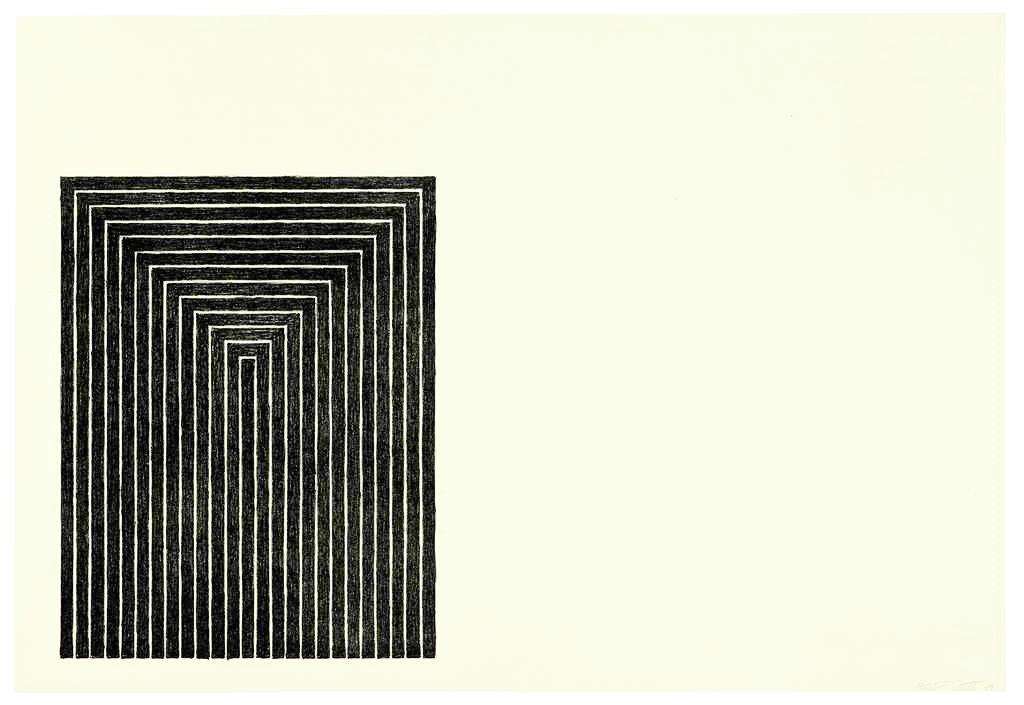
Stella’s first print, Rabat (1964), was his contribution to the Ten Works x Ten Painters portfolio published by the Wadsworth Atheneum, alongside Andy Warhol, Roy Lichtenstein, Ellsworth Kelly, Robert Motherwell and Ad Reinhardt. Its edition of 500 keeps it accessible today. The Black Series I (1967) reinterprets the Black Paintings as lithographs, confining the stripe motif to the lower left of each sheet, while Star of Persia I and II (1967) introduce colour into the same geometric logic. The V Series (1968), including Ifafa and Quathlamba, takes its titles and conjoined V shapes from Stella’s paintings of the mid-1960s. These are the most affordable route into the artist’s foundational period.
1970s: Colour, Scale and the Protractor Prints
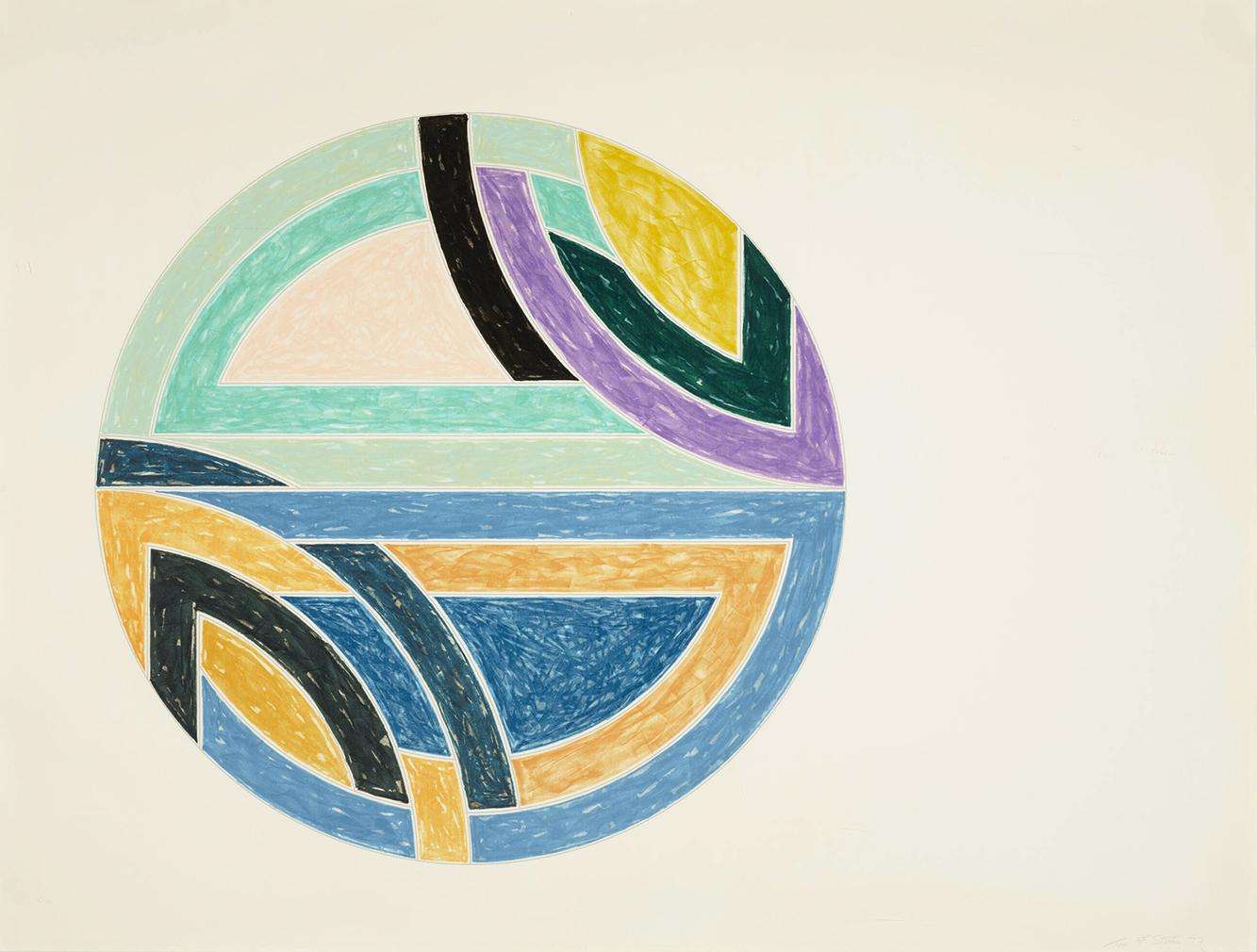
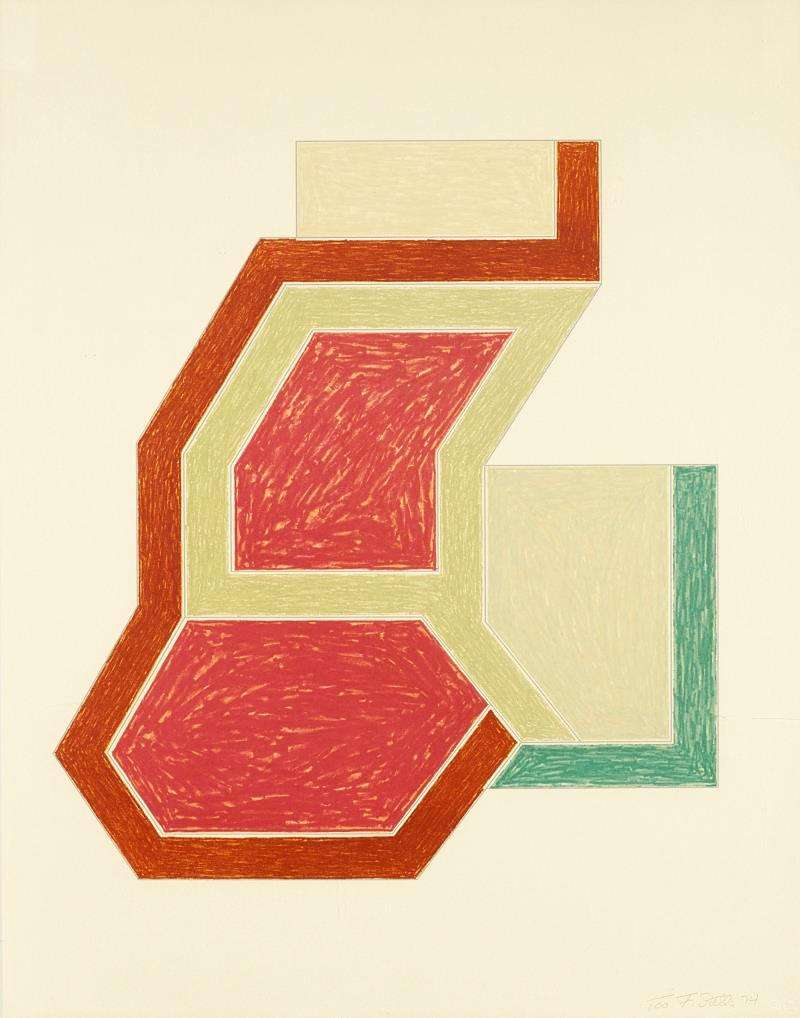
The 1970s brought colour and scale. The Newfoundland Series (1971), related to the Protractor paintings, includes Bonne Bay (edition of 58), currently valued at £21,000–£30,000, and the River of Ponds prints (edition of 78), with River of Ponds II valued at £16,000–£23,000. A complete River of Ponds I–IV set achieved £162,040 ($201,600) with fees at Christie’s New York in April 2023. Double Gray Scramble (1973), a standalone screenprint of concentric squares, belongs to this decade and is discussed below. The Eccentric Polygons (1974), such as Sunapee, remain at the accessible end of the market. The Sinjerli Variations lithographs (1977), published in editions of 100, sit in the middle: Sinjerli Variation I is valued at £7,000–£10,500.
1980s: Relief, Layering and Experimental Editions
From 1980 Stella’s prints became increasingly layered and sculptural, and this is where the highest prices concentrate. Polar Co-ordinates (1980), a series of eight prints dedicated to the racing driver Ronnie Peterson, combines lithography and screenprint and trades in the middle market. Polar Co-ordinates V is valued at £6,500–£9,500. Sinjerli Variations Squared with Colored Grounds (1981), a set of six, has become one of the most sought-after Stella portfolios. The Shards, Circuits and Had Gadya series of 1982–84 mark the shift to relief printing and mixed techniques. The Circuits prints, including Pergusa Three (1983), were issued in editions of around 30, and Circuits has been the strongest-performing series by median price over the past five years.
1990s: Moby Dick and Large-Format Works
In the early 1990s Stella turned to Herman Melville’s Moby-Dick, producing prints of extraordinary scale and density such as Stubb and Flask Kill a Right Whale (1992, edition of 27) and The Funeral (1993), alongside the more restrained Jonah Historically Regarded. The period culminated in The Fountain (1992), a work spanning more than seven metres across three sheets, published by Tyler Graphics. These large relief works appear infrequently and are best approached with specialist advice on condition and framing.
Is Frank Stella a Good Investment?
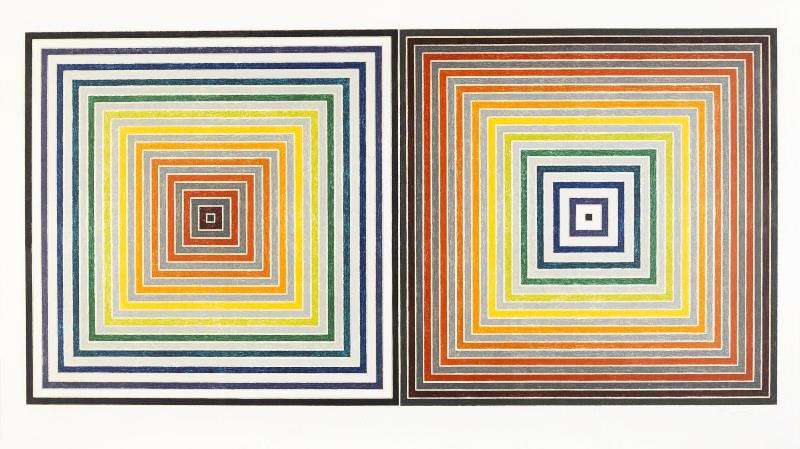
Stella’s print market is best understood title by title rather than as a single trend. At the top, the benchmarks have strengthened. Double Gray Scramble trades at auction regularly, with recent hammer prices between around £52,000 and £98,421. The October 2026 result at Sotheby’s New York, £125,784 ($166,400) with fees, was its strongest since the 2018 record. Because it trades regularly, it offers buyers one of the clearest price records of any Stella print.
The October 2026 Christie’s online sale Graphic Alchemist: Works from the Estate of Frank Stella added further reference points. Of 65 lots, 61 sold for a combined $1,793,920 with fees, against presale estimates of 755,000–1,086,000. An artist’s proof set of Sinjerli Variations Squared with Colored Grounds made $307,200 against an estimate of 60,000–80,000, and The Fossil Whale (Dome) (AP) reached $140,800 against 15,000–20,000.
Those results reflect rare proofs that came directly from the artist’s own collection, and they should not be read as a market-wide revaluation. In the middle market, several titles have softened over five years: on MyArtBroker data, Polar Co-ordinates V has shown an average annual change of −10% and Pergusa Three −3%. For buyers, that divergence is the point. Benchmark works and proofs from the artist’s collection now command clear premiums, while well-documented mid-market prints from the 1970s and 1980s can still be bought below their earlier peaks.
The Most Sought-After Frank Stella Prints
The Fountain (1992). Stella’s print auction record: $375,000 (£290,360) with fees at Christie’s New York in October 2019. Published by Tyler Graphics and combining several printing techniques across three sheets of handmade paper, it is among the most ambitious and rarely available works in his printmaking.
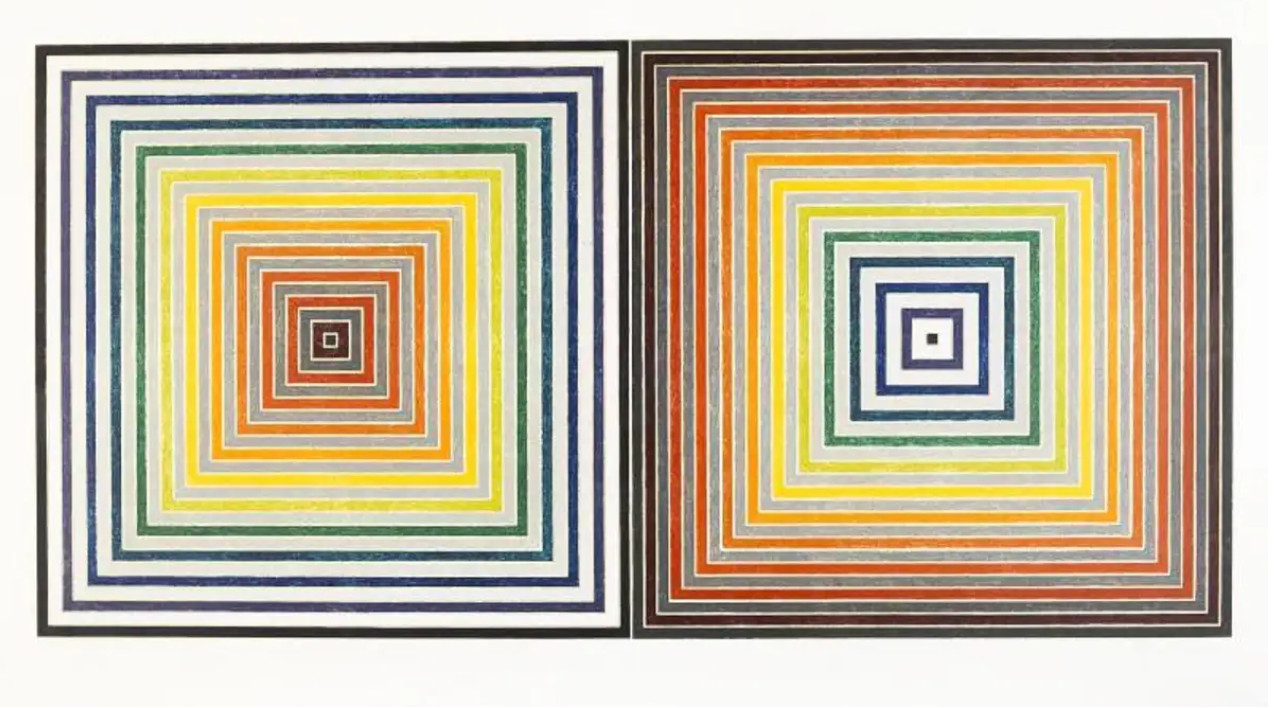
Double Gray Scramble (1973). A screenprint of nested concentric squares in an edition of 100, echoing Stella’s concentric-square paintings. Its record of £252,774 ($324,500) with fees was set at Christie’s New York in November 2018, and it has sold 20 times at auction since 1998. An artist’s proof sold for £71,529 at Bonhams in 2024, within the trading range of the numbered edition. MyArtBroker’s current market value is £90,000–£130,000.
Sinjerli Variations Squared with Colored Grounds (1981). An artist’s proof set of all six prints achieved £229,254 ($307,200) with fees in the October 2026 estate sale. That is the third-highest auction price for a Stella print.
River of Ponds I–IV (1971). Complete sets from the Newfoundland group are scarce. The April 2023 Christie’s result of £162,040 ($201,600) with fees remains the reference for buyers seeking the full portfolio.
Pergusa Three (1983). A relief print from the Circuits series in an edition of 30, valued at £40,000–£60,000. Its highest recent result was £64,901 at hammer in March 2022.
How to Authenticate a Frank Stella Print
Authentication begins with the catalogue raisonné. Richard H. Axsom catalogued Stella’s prints in two publications: The Prints of Frank Stella: A Catalogue Raisonné, 1967–1982 (1983) and Frank Stella Prints: A Catalogue Raisonné (2016), which documents more than 300 editioned prints. The two cover different periods and may use different numbering, so always confirm which publication an Axsom number refers to. A genuine print should match its documented title, date, medium, dimensions and edition structure.
Beyond the catalogue, check the signature and numbering, and look for the blindstamps of the workshops Stella worked with, principally Gemini G.E.L. and Tyler Graphics, whose records provide supporting evidence. Trial proofs and colour variations need particular care, since legitimate impressions can differ from the standard edition. A certificate of authenticity is useful documentation but no substitute for examining the print, its catalogue reference and its provenance.
How to Check the Condition of a Frank Stella Print
Stella often printed on handmade or specially commissioned papers. These can be prone to discolouration, foxing and acid burn, and his saturated colour fields can fade with prolonged light exposure. The relief and mixed-media prints of the 1980s and 1990s need extra scrutiny: raised, embossed or collaged passages can crush, crack or separate, and metallic inks may deteriorate. Before buying, request images of the work unframed, front and reverse, paying close attention to edges and to any signs of improper mounting. For larger or relief works, a condition report from a paper conservator is worth commissioning, and specialist framing should be budgeted for.
Where to Buy a Frank Stella Print in 2026
Auction houses offer visibility and a public price record, but buying there has become more expensive. Christie’s charges a buyer’s premium of 28% on the first $2 million of the hammer price, matching the structure at Sotheby’s, while Phillips charges up to 29% on lower-value lots. For a Stella print in the £5,000–£20,000 range, that adds substantially to the final cost. Auction timing also means buyers have to wait for the right impression to come up in a given season.
Private sale offers an alternative. Prices are agreed upfront, works can be sourced on request rather than waiting for the auction calendar, and buyers can review condition and documentation before committing. Stella’s market is so title-specific that a specialist who can compare a particular impression with recent sales of the same work is often worth more than a broad view of the artist’s averages.
Why Buy a Frank Stella Print with MyArtBroker?
MyArtBroker specialises in the private sale of modern and contemporary prints and editions. Our specialists source specific Stella works on request through a network of over 30,000 collectors, dealers and galleries, and check condition, documentation and catalogue references before any sale. Our Trading Floor shows live market activity across Stella’s prints, and MyPortfolio lets you track the value of your collection over time. If you’re looking for a particular Stella print, speak with our specialists or browse available works on the Trading Floor.