
Key Takeaways
How to Sell A Jean-Michel Basquiat Print
- Identify which tier your print sits within: estate edition, Anatomy, 1983 lifetime screenprint, or signed canvas edition.
- Assess imagery strength – crowns, skulls, and text-driven compositions consistently attract the strongest demand.
- Confirm edition size, publisher, and documentation before approaching the market.
- Align placement strategy with rarity and value level.
- Prioritise condition – surface integrity and colour retention materially influence outcome.
This guide outlines how Basquiat’s market functions in 2025 – and how sellers can position estate editions, Anatomy works, and lifetime prints strategically within a disciplined, placement-led environment.
Is Now a Good Time to Sell a Jean-Michel Basquiat Print?
Basquiat’s print market in 2026 is selective and thinly traded. Open-auction results for his prints and print sets total £920,000 hammer from 13 priced lots so far this year, compared with £1.02m in 2025 and £2.33m in 2023. Nearly half of this year’s total comes from a single lot: a complete set of [Anatomy] artist’s proofs, which made £447,554 hammer (£568,393 with fees) at Christie’s New York on 21 May 2026.
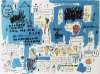
Estate editions account for most of the activity. At Western auction houses, single estate prints have made between £20,735 and £58,958 hammer in 2026. [Piano Lessons] has sold three times, at £30,000–£34,361, while [Flexible] made £58,958 at Christie’s New York in April.
Where a work is sold can matter as much as when. Flexible made £122,902 hammer at SBI Art Auction in Tokyo in March 2026, roughly double its New York result a month later. SBI also achieved £113,849 for the image in 2023, while standard impressions offered at Western houses between 2023 and 2026 made £43,605–£58,958.
With lifetime works tightly held and appearing only infrequently, current conditions favour well-preserved impressions with strong visual identity. Outcomes are being shaped less by market momentum than by the quality of the individual work and how and where it is introduced. This is a market defined by strategic placement rather than urgenc
Jean-Michel Basquiat Market Performance – What Is Driving Value In The Basquiat Market?
Basquiat’s print market is underpinned by his position in the wider contemporary market. His paintings remain among the sector’s most sought-after works and regularly anchor major evening sales. This high-profile auction presence supports the market for his editions, particularly when recognisable imagery connects them to his most celebrated works.
Basquiat Exhibition Presence
To name a few recent examples: the Fondation Beyeler’s presentation of the Modena Paintings, prominent dealer showcases at Art Basel including Jeffrey Deitch’s presentation of Valentine and the monumental shaped canvas Now’s the Time, and luxury-backed collaborations linking Basquiat with figures such as Andy Warhol under the LVMH umbrella.
Basquiat’s market is also closely associated with blue-chip representation at the highest level, including Larry Gagosian’s long-standing involvement in placing and exhibiting major works. Institutional exhibitions, dominant gallery presence, and cross-sector cultural partnerships ensure that his name remains continuously visible within both the art world and the wider luxury sphere.
Why This Matters For Sellers
This sustained institutional and commercial visibility reinforces Basquiat’s cultural centrality and underpins cross-generational demand. When his paintings command attention at the top of the market, confidence extends through his editions.
Lifetime prints remain exceptionally scarce and attract concentrated competition when they appear. Estate editions – reproducing his most recognisable imagery – provide active liquidity at accessible tiers.
Rarity at the top and volume below operate together. Ongoing institutional exposure sustains demand, and that demand supports resilience and pricing stability across the print market.
How Much Is My Jean-Michel Basquiat Print Worth?
Edition type provides the starting point for assessing a Basquiat print. Rare 1983 lifetime works, individual Anatomy sheets, complete portfolios and posthumous estate editions each follow different pricing patterns, with imagery, rarity, format and condition creating further variation.
Basquiat Posthumous Estate Editions
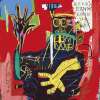
Estate editions form the core of the market and often achieve higher prices than single Anatomy sheets. Value is strongly imagery-led: crown motifs, skull compositions such as Cabeza, and text-heavy works aligned with Basquiat’s most recognisable visual language tend to attract stronger results.
Pricing can also respond to supply. Repeated appearances establish clearer benchmarks, while less frequently offered images may attract greater competition when a strong impression comes to market.Estate prints form the core of the market and often achieve higher price levels than Anatomy works due to scale and subject. Here, value is primarily imagery-led. Crown motifs, skull compositions such as Cabeza, and text-heavy works aligned with Basquiat’s most recognisable visual language consistently command stronger results.
Basquiat Lifetime Signed Prints
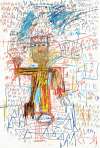
Basquiat’s 1983 signed screenprints occupy the top of the print market. Issued in very small editions and signed during his lifetime, they are extremely scarce and appear infrequently at auction. Their value reflects their rarity, signature and position within Basquiat’s limited lifetime print production.
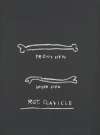
The lifetime-signed Anatomy series trades at more accessible prices when offered as individual sheets. Since 2023, single sheets have made between £11,724 and £29,628 hammer at auction, with results varying according to the image and condition. Complete sets occupy a different price bracket entirely, as demonstrated by the £447,554 hammer result achieved at Christie’s in May 2026.
Across the market, preservation materially affects value. Surface quality, colour retention and margin integrity can create significant differences between impressions from the same edition.
How to Verify Your Jean-Michel Basquiat Print Before Selling
Basquiat’s Authentication Committee was disbanded in 2012, and the Estate no longer accepts works for authentication. Verifying a print therefore depends on its provenance and consistency with the documented details of the edition, including its publisher, printer, paper, dimensions, numbering and identifying marks.
Basquiat Estate Signatures and Certificates
Posthumous estate editions were not signed by Jean-Michel Basquiat. Depending on when they were published, they may carry an estate stamp and the signatures of estate administrators Gérard Basquiat or Lisane Basquiat and Jeanine Heriveaux.
The precise form of this documentation varies by edition. Some works have a signed certificate affixed to the reverse, while others carry estate signatures or stamps directly on the sheet. For example, impressions of Cabeza carry a stamped certificate signed by Gérard Basquiat, while Flexible was issued with documentation signed by Lisane Basquiat and Jeanine Heriveaux.
Any certificate, label or accompanying paperwork should correspond exactly with the print’s title, publication year, edition number, dimensions, publisher and identifying marks. Missing or inconsistent documentation can create questions at resale.Most estate-authorised editions are not hand-signed by Basquiat. Instead, they were released with estate-authorised signature markings, which can vary depending on when the edition was produced and who was managing estate oversight at the time. Those signature differences do not typically change value on their own; the market weights imagery, condition, and edition structure more heavily.
Publisher and Printing Records
The Enrico Navarra publications are widely used as scholarly references for Basquiat’s work, particularly his paintings, but they do not provide a simple authentication process for every print. Sellers should instead consult the records for the specific edition and seek advice from an established prints specialist or auction house when attribution or documentation is unclear. Basquiat does not currently have an active authentication committee.
Forgery Risk and Why Documentation Matters
Basquiat’s market carries significant forgery and misattribution risk. Unauthorised reproductions, incorrectly described estate editions and works with weak provenance can all enter the market. The Estate itself warns that numerous inauthentic works circulate under Basquiat’s name. Clear provenance and edition-specific documentation are therefore central to establishing resale confidence.Basquiat’s market carries meaningful forgery risk, particularly with works that lack clean publishing records or come with vague provenance. Unauthorised prints and misattributed editions do circulate, and this is exactly why resale confidence is built from verifiable documentation rather than informal assurances.
How to Conserve Your Jean-Michel Basquiat Print to Retain Value
Lifetime prints may show signs of age, but light exposure, paper toning, handling marks and margin damage can still affect value. Full margins should be preserved, and any cleaning or repair should be undertaken by a qualified paper conservator. Unsympathetic restoration or permanent mounting can make a work harder to sell.
Posthumous estate editions were produced more recently and are generally expected to remain in strong condition. Discolouration, abrasion, handling creases or framing damage can therefore have a pronounced effect on buyer confidence.
Basquiat prints should be framed using UV-filtering glazing and archival, acid-free materials. They should also be kept away from direct sunlight and significant fluctuations in temperature or humidity. Any work requiring treatment should be assessed by a paper conservator before intervention.
Where Can I Sell My Jean-Michel Basquiat Print In 2026?
Basquiat prints can be sold at auction or through a private sale. The right route depends on the edition, its condition and documentation, current buyer demand and the number of comparable impressions already on the market.
Auction or Private Sale?
Auction provides public exposure and competitive bidding on a fixed date. A strong result becomes a visible benchmark for the edition, but the seller has limited control once the sale begins. Seller’s commission and other agreed costs may be deducted from the hammer price, while an unsold lot or weak result can affect how the work is positioned in a future sale. Timing also matters, particularly when several impressions of the same edition are offered within a short period.
Private sale offers greater discretion and flexibility over timing and asking price. The work can be presented directly to buyers seeking that particular edition without publishing an estimate or exposing it to a public auction result. However, the effectiveness of this route depends on the intermediary’s access to relevant buyers and its understanding of current demand.
Selling a Jean-Michel Basquiat Print with MyArtBroker
MyArtBroker specialises in the secondary market for Basquiat prints. Our specialists work across his limited lifetime print production, individual Anatomy sheets, complete portfolios and posthumous estate editions. Combining current market data with active buyer relationships allows us to position each work according to its edition type, imagery, condition and current demand.
Valuation and Market Positioning
Every work is assessed individually against recent Basquiat auction results, private sale comparables, edition details, condition, provenance and documentation. Pricing reflects current demand for the specific work rather than headline results or generalised estimates. Sellers can begin with our Instant Valuation tool to receive an initial data-backed benchmark. A specialist review then refines the valuation and recommends a sale strategy based on the work and current market conditions.
0% Seller’s Commission
We charge 0% seller’s commission on private sales. No seller fees are deducted from the agreed return, no public estimate is attached to the work, and an unsuccessful private offering does not enter the public auction record.
Our objective is to return sellers the equivalent of the hammer price that the work could reasonably achieve at auction, before the deduction of seller’s commission. We instead charge the buyer a commission on the sale. This structure is designed to return more to the seller than the same hammer result at auction once seller’s commission is taken into account.
Global Buyer Network and Private Placement
Through our international collector network and Trading Floor, Basquiat prints are introduced directly to buyers seeking specific editions. This allows supply to be matched with current demand without publicly marketing the work or attaching an auction estimate.
Get in touch with our specialists to discuss selling your Basquiat print.