

Hockney's print market enters a new chapter in 2026. Following the artist's passing in June at the age of 88, renewed attention has been placed on one of the most influential printmaking legacies of the post-war period. This comes after a record-breaking 2025, when Hockney print sales exceeded £15.9 million.
Is Now A Good Time To Sell A David Hockney Print?
For many sellers, 2026 presents a favourable opportunity to bring a Hockney print to market. Following the artist's passing, renewed attention has naturally been placed on one of the most influential printmaking legacies of the post-war period. However, interest in Hockney's market was already building long before his death.
Over the past two years, a series of major institutional and commercial moments have reinforced Hockney's position at the centre of the art world. The return of David Hockney: Bigger & Closer (not smaller & further away) at Lightroom introduced new audiences to his digital practice, while Sotheby's dedicated a landmark sale to The Arrival of Spring, followed by the release of a second major collection in 2026. The Serpentine's exhibition of Hockney's Bayeux tapestry, his painted window installation at Turner Contemporary and the Tate's announcement of a major retrospective for 2027 have all continued to strengthen his legacy. What would have been his 89th birthday, on 9 July, also prompted renewed reflection on the extraordinary breadth of his career and contribution to contemporary art.
For sellers, Hockney's market is not being driven by a single event. His passing has undoubtedly focused attention on his work, but collector interest has been building for years through major exhibitions, technological innovation and sustained institutional recognition. That broader foundation suggests the current strength of Hockney's print market is supported by long-term cultural significance rather than short-term sentiment alone.
Results since his death show strong but selective demand. In October 2026, 10th – 22nd June 2021, Water Lilies in the Pond with Pots of Flowers sold for £1,573,770 hammer (£1,920,000 with fees) in a Sotheby's online sale, well above its £450,000–650,000 estimate. Not every image has moved in the same direction, so recent sales of your specific print matter more than the headline results.
How Much Is My David Hockney Print Worth in 2026?
There is no single value for a Hockney print. Prices vary according to the series, edition type, rarity, condition and recent auction performance. While Hockney's print market reached record levels in 2025, demand has remained concentrated around a handful of key collections. Not every collection has followed the same trajectory.
Some series have become established blue chip markets, while others are entering new phases of growth. Hockney's Swimming Pools remain among his most iconic and consistently sought-after images, underpinned by decades of collector demand. The Arrival of Spring has undergone a significant market reappraisal in recent years, establishing itself as one of the strongest-performing collections in his print market. Moving Focus continues to attract growing interest as collectors increasingly embrace Hockney's digital practice and bold abstract compositions, while the Yosemite Suite remains a comparatively underdeveloped market that many specialists continue to watch closely.
The sections below explore each of these collections in more detail. If your print falls outside them, the most reliable way to assess its value is by comparing it with recent sales of the same image, edition type and proof designation before seeking a professional valuation.
The Arrival of Spring Print Value
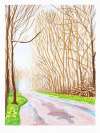
The Arrival of Spring has become one of the strongest-performing areas of Hockney's print market. Sotheby's dedicated white-glove sale established a series of new six-figure benchmarks. Those results reflected an exceptional combination of matching edition numbers, distinguished provenance and carefully timed market positioning. Demand has continued since. In June 2026, The Arrival of Spring in Woldgate, East Yorkshire in 2011 (twenty eleven) – 30 May, from the edition of 10, sold for a hammer price of £400,000 at Sotheby's London, above its £250,000–350,000 estimate.
For individual sellers, value still depends on the specific composition, condition and recent comparable sales. With more than 60 individual images, prices vary considerably. Compositions featuring winding paths, roads and strong reflections have historically attracted the greatest competition. Fresh-to-market impressions can often outperform works that have traded more recently, but there has also been strong competition for compositions that have traded multiple times on the market.
Moving Focus Print Value
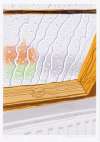
Moving Focus has become one of the most closely watched areas of Hockney's print market, with renewed collector interest driving strong prices in 2025. An Image of Celia (State I) sold for £148,840 at Bonhams Los Angeles in April 2025, while Hotel Acatlán: Second Day reached £143,323 at Sotheby's New York in May (both hammer prices), demonstrating growing demand across the series rather than for a single standout image. Prices can also ease. Another impression of Hotel Acatlán: Second Day made £110,856 at Wright in September 2026, below its 2025 result.
Unlike Hockney's landscape prints, Moving Focus combines interiors, architectural scenes and abstract compositions, giving collectors a broad range of imagery while remaining part of a cohesive body of work. For sellers, the strongest prices continue to be achieved by rare proofs, visually distinctive compositions and exceptional condition.
Swimming Pools Print Value
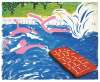
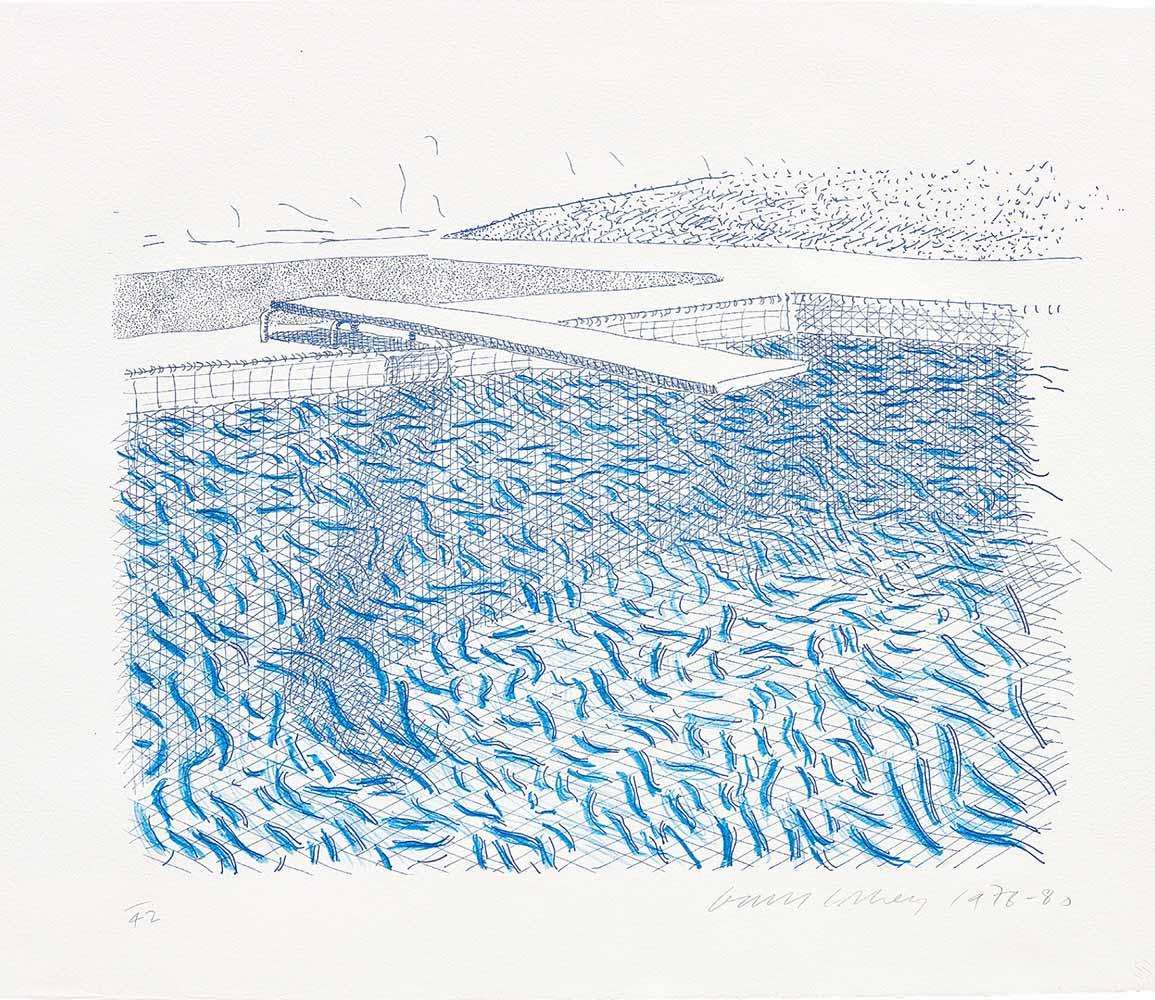
Hockney's swimming pool prints span multiple series and printmaking techniques rather than a single collection. Together, they represent the artist's most recognisable imagery, capturing the sunlit Californian landscapes that have become synonymous with his work. Their cultural significance and broad collector appeal have made them one of the most consistently sought-after areas of Hockney's print market.
The earliest lithographic swimming pool prints have become increasingly scarce, with many now held in long-term private collections. As a result, values are driven by a combination of rarity, condition and collector preference for particular compositions and colourways. Afternoon Swimming is among the rarest and most desirable examples. When it appeared at Christie's New York in October 2025, it achieved a hammer price of £180,505, demonstrating the strong competition that exceptional impressions can generate.
Within this category, condition plays a particularly important role. Collectors place a premium on vibrant colour, clean margins and well-preserved paper, meaning even relatively minor condition issues can have a noticeable impact on value.
The Yosemite Suite Print Value
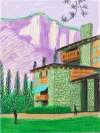
The Yosemite Suite occupies a distinctive position within Hockney's digital print market. Although average prices have consistently exceeded many other digital works, the series has appeared at auction relatively infrequently, limiting opportunities for price discovery.
Much of the market's value is concentrated in the larger-format Bigger Yosemite works, produced in editions of just ten. Several have never appeared at auction, meaning the series' highest-value segment remains largely untested. This combination of scarcity and limited public trading positions The Yosemite Suite as one of the most closely watched areas of Hockney's market.
For sellers, growing institutional recognition of Hockney's digital practice, combined with the limited supply of these works, continues to support long-term confidence in the series.
What Are David Hockney Artist's Proofs and Trial Proofs Worth?
Most Hockney prints were issued as numbered editions, with proofs appearing only occasionally on the secondary market. Across public auction sales in 2025 and H1 2026, fewer than 13% of works offered were artist's proofs, printer's proofs or complete portfolios, reinforcing just how rarely these works become available.
Because they are produced in much smaller numbers than the standard edition, proofs can command premiums when they appear. Their value, however, depends on the individual print rather than the proof designation alone. A rare proof of a highly sought-after image can attract competitive attention, but proof status alone is not enough to guarantee a premium.
The limited number of public sales means there are often few directly comparable examples. For sellers, correctly identifying the proof designation and ensuring it is supported by catalogue references, provenance and edition documentation is essential before bringing the work to market. Specialist advice can be particularly valuable where there is little recent auction evidence to guide pricing.
David Hockney Signed vs Unsigned Print Value
The secondary market for Hockney prints is overwhelmingly built around signed editions. Between January 2025 and June 2026, more than 550 signed Hockney prints were offered at auction. Unsigned Hockney prints do exist, most commonly as separated sheets from portfolios or incomplete sets. While these works may be genuine, they rarely enter the established public market because provenance, catalogue references and publication history are often more difficult to verify. As a result, sellers of unsigned works should expect significantly greater scrutiny before bringing them to market.
This is particularly relevant for Hockney's early lithographic swimming pool prints, where unsigned sheets occasionally surface independently despite not being recognised as standalone editions within the catalogue raisonné. Before seeking a valuation, it is advisable to confirm the work's catalogue status and supporting documentation, as these factors will heavily influence buyer confidence and the most appropriate route to market.
How to Authenticate A David Hockney Print Before Selling
Authenticating a Hockney print is an important step before bringing it to market. Unlike some artists, Hockney's prints are not typically accompanied by certificates of authenticity, and their absence does not necessarily affect value. Instead, buyers rely on recognised catalogue references, provenance and publisher records to confirm a work's authenticity.
Does the David Hockney Foundation Authenticate Prints?
The David Hockney Foundation maintains an extensive archive and supports scholarship but does not authenticate works or issue certificates of authenticity. A comprehensive catalogue raisonné is currently in preparation, although it is expected to begin with paintings rather than prints. Until then, Hockney's print market relies on established documentation, publisher records and recognised reference catalogues.
Three principal catalogues continue to underpin the market for Hockney's earlier prints:
- S.A.C. – David Hockney Prints 1954–77, Scottish Arts Council (1979)
- M.C.A.T. – David Hockney Prints 1954–1995, Museum of Contemporary Art Tokyo (1996)
- T.G. – Tyler Graphics: Catalogue Raisonné, 1974–1985 (1987)
Because these catalogues end in 1995, later bodies of work – including the iPad Drawings, The Arrival of Spring and The Yosemite Suite – are not yet covered by a published catalogue raisonné. For these prints, provenance, publisher records and exhibition history become even more important when establishing authenticity.
Before selling, it is also worth reviewing your print's documentation. Gallery invoices, previous auction records and correspondence relating to the original purchase can all help strengthen provenance. Buyers will also expect the signature, edition number and publisher details to align with the recognised edition. Prints published by workshops such as Gemini G.E.L., Petersburg Press, Editions Alecto and Tyler Graphics benefit from well-established publication histories that provide additional confidence.
For particularly rare works, such as artist's proofs, printer's proofs and complete portfolios, comprehensive documentation becomes even more important, as there are often fewer comparable examples available to support valuation.
David Hockney Print Condition and Conservation
Condition is one of the most important factors influencing the value of a Hockney print. Collectors and specialists will assess not only the quality of the image but also the paper, margins and any evidence of previous restoration. Even relatively minor condition issues can affect value, particularly for rare editions and works from Hockney's most sought-after series.
The most common issues include fading caused by prolonged exposure to light, foxing, paper discolouration, creases, handling marks and damage resulting from poor framing or acidic mounts. Original condition is generally preferred, and unnecessary restoration can sometimes reduce buyer confidence more than the defect itself. Where conservation is required, it should always be carried out by an accredited paper conservator and fully documented.
Before bringing a Hockney print to market, it is advisable to have its condition professionally assessed. Clear condition reporting, careful storage and conservation-grade framing can help preserve both the print and its long-term value. For more advice on protecting your collection, read our guide to How to Frame David Hockney Prints.
Where Can I Sell My David Hockney Print In 2026?
For collectors selling in the secondary market, the choice of channel directly affects net proceeds, pricing control, and how a work is positioned against comparable supply. The two primary routes – auction and private sale – operate very differently in terms of risk, fees, and market exposure.
Selling at Auction – Fees and Public Exposure
A strong result can reset benchmarks and reinforce Hockney print prices in the public record. It also introduces fixed sale dates, public estimate ranges, buyer's premiums, and seller's commission. An unsold lot or a result below estimate becomes a permanent part of the auction record, with consequences for future pricing. When comparable impressions are already available in the same season, competing supply can further limit upside.
Selling via Private Sale
Private sale offers discretion, flexible timing, and direct access to qualified buyers actively seeking specific editions. Pricing is informed by current auction data without exposing the work to public price discovery or the risk of an unsold lot entering the record. Private sale offers greater control over both timing and outcome.
Private sale is our core service, but it isn't always the right route. MyArtBroker partners with auction houses, and if we believe a work will perform better at auction, we'll tell you upfront.
Why Sell with MyArtBroker
MyArtBroker is the secondary market specialist for Hockney prints. Our dedicated specialists buy, sell and value Hockney every day – across edition types, states, and impression quality – and we maintain live collector demand across his print portfolio globally. That combination of market intelligence and active buyer relationships means we can position each work precisely, and transact directly through our private marketplace.
Valuation and Market Positioning
Every work is assessed individually against recent Hockney auction results, edition structure, state, and private sale comparables. Pricing reflects current demand, not headline estate benchmarks or generalised estimates. Sellers can begin with our Instant Valuation tool, which provides a real-time pricing range drawn from verified auction data and private sale intelligence. A specialist review then refines placement strategy based on the specific work and current market conditions.
0% Seller's Commission
We charge 0% seller's commission. There are no seller fees deducted from the final price, no public estimates attached to the work, and no risk of the work publicly going unsold - as with auction. Our objective is to return our sellers the equivalent hammer price, were the work to sell at auction. We charge the buyer a competitively low commission on sale. Combined with direct access to our global collector network, this structure is designed to return more to the seller than the same result at auction, once seller's commission is taken into account.
Global Buyer Network and Private Placement
Through our international collector network and Trading Floor, Hockney prints are introduced directly to buyers actively seeking specific editions. Supply is matched to verified demand, reducing exposure risk and shortening time to transaction.
Get in touch with our specialists to discuss selling your Hockney print.