The World's Largest Modern & Contemporary Prints & Editions Platform
Chocolate Buddha (complete set)

Chocolate Buddha (complete set)
Signed Print
Keith Haring
56 x 71cm, Edition of 90, Lithograph, 1989
£45,000-£70,000
$90,000-$140,000 Market Value Indicator
$80,000-$130,000 Market Value Indicator
¥400,000-¥620,000 Market Value Indicator
€50,000-€80,000 Market Value Indicator
$470,000-$720,000 Market Value Indicator
¥9,470,000-¥14,740,000 Market Value Indicator
$60,000-$90,000 Market Value Indicator
There aren't enough data points on this work for a comprehensive result. Please speak to a specialist by making an enquiry.
Track Auction Value Trend
Meaning & Analysis
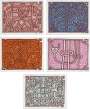
Chocolate Buddha (complete set) is a portfolio of five lithographs by Keith Haring, made in 1989 in a signed edition of 90. Each sheet presents a dense, interlaced composition drawn in deep brown line over a single ground of red hatching, blue, orange, pink or turquoise, enclosed by a squared key-pattern border. Together they form the complete Chocolate Buddha series.
The Chocolate Buddha prints show Haring moving away from the open, outlined figures of his Pop Shop imagery towards something closer to ornament. Lines loop, knot and interlock across each sheet until figure and pattern become difficult to separate. A head with dotted features emerges in the first and third plates, mirrored profiles face one another across the second, and in the fourth a horned, spotted head sits among broad white bands set against a field of script-like marks. The final plate is the most labyrinthine, its channels winding around a central knot.
The title and the knotted forms invite comparison with Buddhist imagery, in particular the endless knot, a symbol of interconnection. The borders, with their scrolling corners, recall the frames of textiles and decorative panels and reinforce the sense of each print as a self-contained pattern. The warm brown line, which appears to give the series its name, sets it apart from the black outline that defines most of Haring's printed work. Made the year after his AIDS diagnosis, during a period of extensive travel and work in Europe and Japan, the portfolio reflects the denser, more inward-looking direction of his late output.