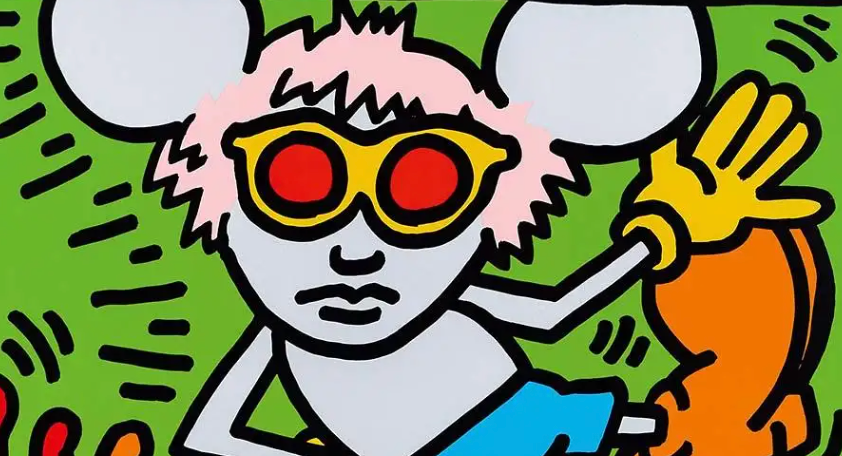


The Genesis of Andy Mouse, Haring Meets Warhol
In the transformative 1980s art scene, Haring and Warhol's paths crossed, beginning a friendship and mutual influence that would leave a lasting mark on the art world. After their first meeting around 1983 at the Tony Shafrazi Gallery, Haring, a rising force in street art known for his public and subway drawings, found a mentor in Warhol, the established master of Pop Art, whose work had integrated commercial imagery and artistic expression since the 1960s. Warhol's influence went beyond admiration and helped guide Haring's practice, encouraging him to explore the intersections of art with performance, music and dance.
Haring's Andy Mouse series is a testament to this friendship and mutual respect. While not a collaboration in the strictest sense, the series is Haring's homage to Warhol, combining the imagery of Mickey Mouse with Warhol's aesthetic and persona and bridging two generations. It celebrates Warhol's influence on Haring and reflects both artists' fascination with pop culture and the commercialisation of art.
Conceptualising Andy Mouse, a Fusion of Icons
Haring's approach to Andy Mouse was shaped by his admiration for Warhol's work and his wish to pay tribute to his friend. He took the much-loved image of Mickey Mouse, a figure that, like Warhol's Campbell's Soup Cans, embodied the meeting of commerce and culture, and filled it with Warhol's personality and aesthetic.
The strength of Andy Mouse lies in Haring's use of his graffiti-derived line to give the character energy and movement, while Warhol's features and motifs turn Mickey Mouse into a symbol of Pop Art itself. By merging the iconography of Warhol and Mickey Mouse, Haring created not only a visual hybrid but a dialogue between cultural eras and artistic movements.
Andy Mouse shows how Haring's practice was rooted in an understanding of his predecessors, his contemporaries and the cultural forces of his time, allowing him to make work that was both a reflection and a critique of the world around him.
Andy Mouse's Cultural Significance
Andy Mouse emerged in the 1980s against a backdrop of explosive creativity and exchange between artistic disciplines. The period blurred the boundaries between the traditionally exclusive art world and the everyday realm of popular culture. Haring, with a foot in both worlds, used the image to celebrate and critique the commodification of art and its icons. By merging Mickey Mouse with the figure of Andy Warhol, he commented on the artist as a brand and on the art market's mechanisms, anticipating today's influencer culture.
The character's significance extends beyond commentary to a form of cultural democratisation. Haring's work was inherently public and accessible, challenging the exclusivity of gallery spaces, and Andy Mouse, with its pop culture references and street art aesthetic, invited a broader audience to engage with contemporary art.
Andy Mouse was also a bridge between artistic communities. It reflected the era's appetite for mixing and remixing symbols and personalities, a tendency that has only intensified in the digital age, and it continues to raise questions about the boundary between artistic merit and popular appeal.
The Visual Language of Andy Mouse
Bold Lines and Graphic Clarity
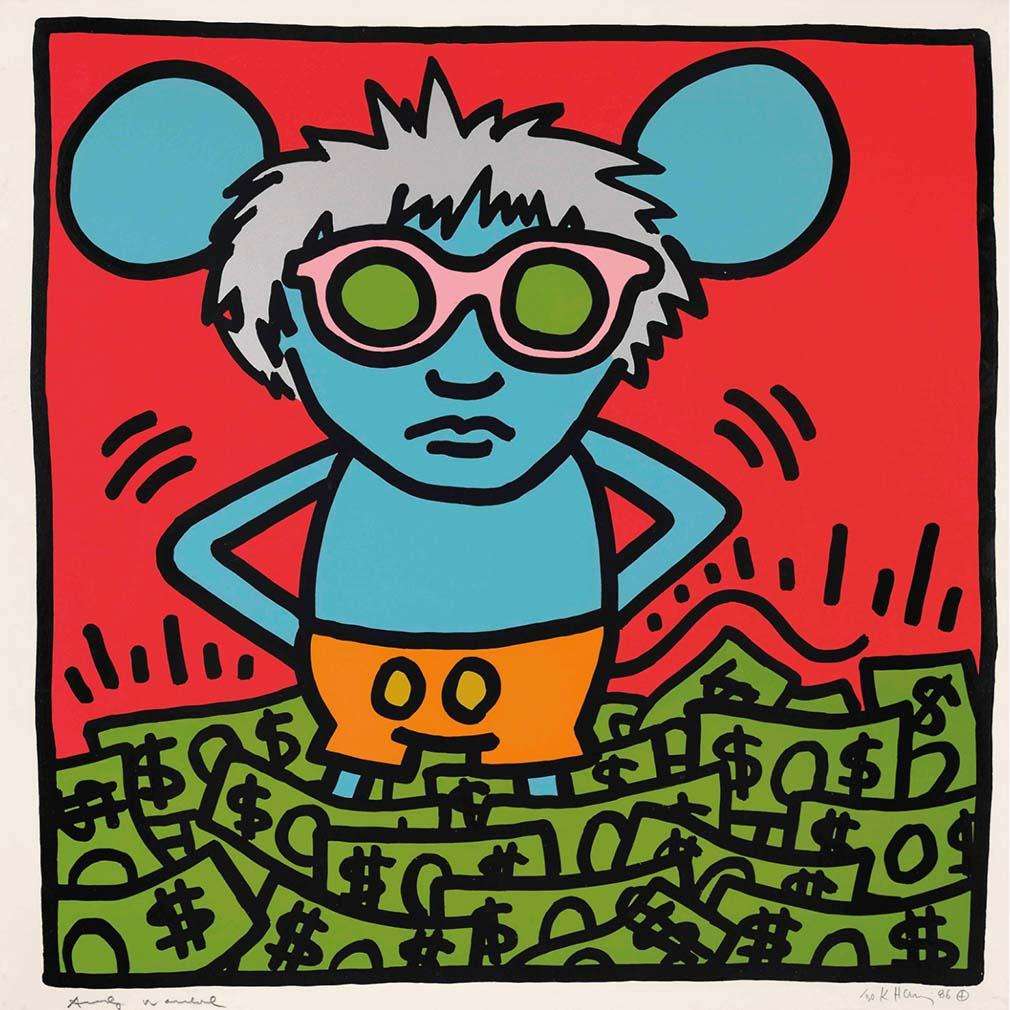
One of the most striking aspects of Andy Mouse is its use of bold, unambiguous lines that define the contours of the characters and elements in the composition. This graphic strength, drawn from Haring's background in graffiti and street art, anchors the image and gives it a sense of movement, making it immediately recognisable.
Vivid Colours
Vivid, often primary colours are central to the series' visual language. They heighten its impact and give it a playful, energetic feel. The bright palette reflects Pop Art's use of commercial and mass-media aesthetics, and Haring's colour choices draw attention to the work's central theme, the meeting of art and commerce.
Pop Culture References
At the heart of Andy Mouse is its fusion of Mickey Mouse and Andy Warhol. The combination pays homage to Warhol's influence on Haring, comments on the commodification of artistic images and draws on the viewer's own cultural associations, giving the work several layers of meaning for a broad audience.
Artistic Value and Appeal
The lasting appeal of Andy Mouse lies in its fusion of high art and popular culture, its commentary on the art world and its visual energy. By marrying the commercial with the conceptual, Haring challenges distinctions between types of art and invites us to reconsider the role of art in society. Andy Mouse is emblematic of its era but remains relevant to current debates about art, fame and value in a consumer-driven culture.
Andy Mouse at Auction in 2026
Andy Mouse was published in 1986 as four screenprints, each in an edition of 30 with ten artist's proofs (AP), and signed by both Haring and Warhol. That small supply means individual prints rarely come to market. Only one sold at auction in each of 2024 and 2025.
In 2026, five came up, the most in any year of the past decade. Together they made $1.01 million (£750,064), almost a third of Haring's individual-print auction value for the year. The strongest was an AP of Andy Mouse 4, which hammered at $280,000 (£206,354), or $355,600 with fees, at Christie's New York in April, the highest price yet for an individual print from the series.
Results varied more than the headline suggests. The three Andy Mouse 3 prints sold this year, two numbered impressions at Sotheby's New York and an hors commerce (HC) impression at SBI Art Auction in Tokyo, ranged from $160,000 (£120,056) to $200,518 (£149,568), around 25% apart. A numbered Andy Mouse 2 achieved $190,000 (£141,375), close to its 2023 result.
The complete set is scarcer still. It sold four times between 2018 and 2023, for between $746,725 (£536,220) and $985,887 (£701,909), but has not appeared at auction since.
For more on how Andy Mouse shaped Haring's market this year, read the Keith Haring Print Market Report 2026. For guidance on signatures and authentication, see our Buyer's Guide to Keith Haring Prints.
Collecting Andy Mouse with MyArtBroker
MAB100, Tracking the Blue Chip Print Market
MyArtBroker’s MAB100 draws on our wider analysis of thousands of prints across established blue chip artists. It ranks 100 works by cumulative spending over five years, with the selection updated quarterly.
The technology compares repeated sales of the same prints to track how prices change. Frequent trading provides collectors with more evidence to assess performance over time, rather than relying on a single exceptional result. For Andy Mouse collectors, this offers wider market context alongside our detailed research into Haring’s editions.
MAB100 also featured in our contribution to Knight Frank’s The Wealth Report 2026, bringing prints into its wider analysis of collectible assets.
MyPortfolio for Keith Haring Collectors
MyPortfolio by MyArtBroker helps collectors manage their Haring prints, including works from the Andy Mouse series. Its tools let collectors track the value of their prints over time, in the way they might follow any other holding, but built around the specifics of the print market. It gives both new and experienced collectors the information they need to make informed decisions about buying and selling Haring's work.
The Legacy of Keith Haring’s Andy Mouse
Haring's Andy Mouse is a cultural milestone that captures an era when art and popular culture converged in new ways. It records the friendship and mutual respect between Haring and Warhol, and marks a transformative period in contemporary art. Through this character, Haring combined artistic invention with pop culture relevance, and the work's engagement with commodification, celebrity and accessibility keeps it relevant to audiences around the world today.



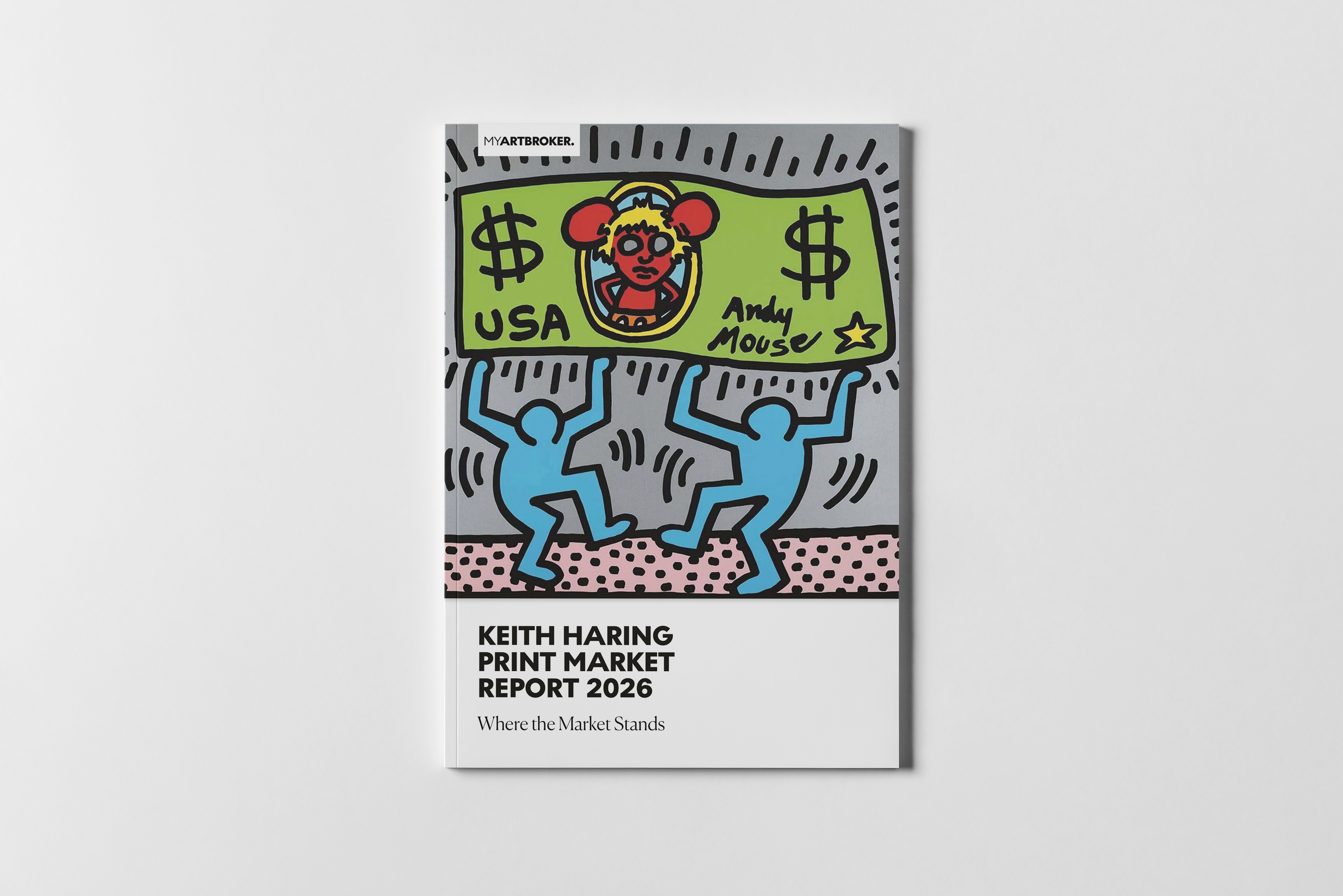
The Keith Haring Print Market Report 2026
Where the market stands, from a record Andy Mouse to steady Pop Shop prices
Keith Haring’s individual prints made £2.38 million at auction by end of October 2026, 72% more than the same period last year. Most of the rise came from a few rare works, and repeat sales rose a median of just 3%. Here’s what that means for buyers and sellers.