The World's Largest Modern & Contemporary Prints & Editions Platform
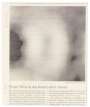
Erster Blick

Erster Blick
Signed Print
Gerhard Richter
18 x 15cm, Edition of 100, Lithograph, 2000
£1,850-£2,750
$3,500-$5,000 Market Value Indicator
$3,500-$5,000 Market Value Indicator
¥16,000-¥24,000 Market Value Indicator
€2,200-€3,250 Market Value Indicator
$19,000-$29,000 Market Value Indicator
¥390,000-¥580,000 Market Value Indicator
$2,450-$3,650 Market Value Indicator
There aren't enough data points on this work for a comprehensive result. Please speak to a specialist by making an enquiry.
Track Auction Value Trend
Meaning & Analysis
Erster Blick is a lithograph by Gerhard Richter, produced in 2000 and signed in an edition of one hundred. The work reproduces a German newspaper clipping reporting the first image of the interior of a single atom – captured by a scanning tunnelling microscope at the University of Augsburg – with the accompanying blurred greyscale photograph of silicon electron clouds reproduced in full. The title comes from the article's headline: First Glimpse into the Interior of an Atom.
The conceit of Erster Blick is quietly devastating. In 2000, a team of physicists at the University of Augsburg achieved what had previously been impossible: using a scanning tunnelling microscope, they produced the first image showing details within a single silicon atom. Their photograph of the electron clouds, published in the journal Science and reproduced in the German press, is an extremely blurred, softly luminous grey form – indistinguishable, at first glance, from the deliberately blurred Photo Paintings Richter had been making for four decades.
Richter appropriates the newspaper clipping in its entirety: headline, article text, caption, and photograph all reproduced as a lithograph, with the edition number and his signature at the left margin. The act of reproduction raises a question the work never makes explicit – whether science has discovered something about photography, or whether Richter's painting has prefigured something about atomic reality. Both readings are available; neither is stable.
This connects to one of the central threads in Richter's practice: the use of found photographic imagery from newspapers, magazines, and scientific publications as material for painting and print. The scanning microscope image is the ultimate found photograph – not of the visible world, but of a world that had never previously been seen at all.