The World's Largest Modern & Contemporary Prints & Editions Platform

Ten Portraits Of Jews Of The Twentieth Century (complete set)
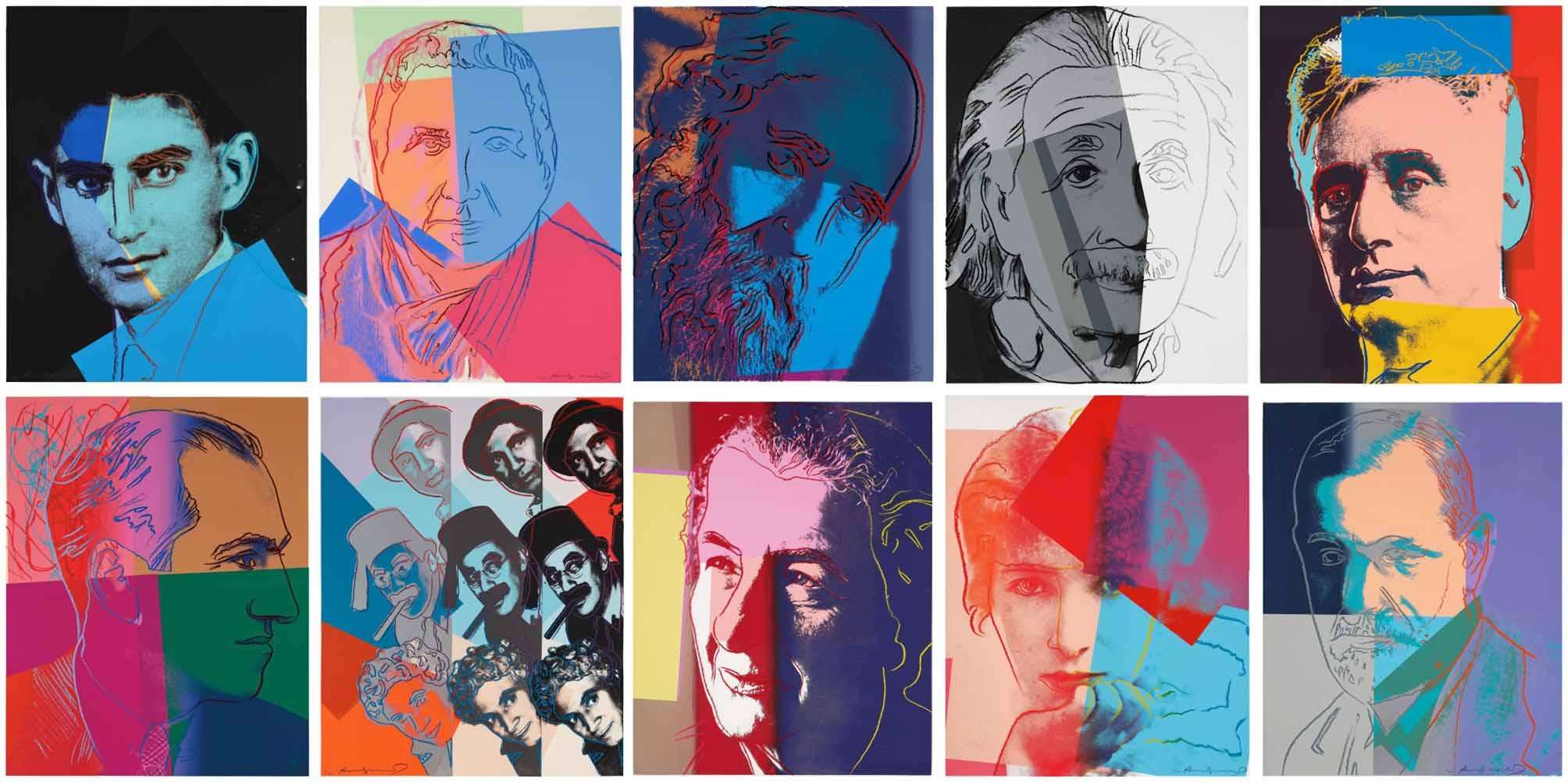
Ten Portraits Of Jews Of The Twentieth Century (complete set)
Signed Print
Andy Warhol
100 x 80cm, Edition of 200, Screenprint, 1980
£510,000-£770,000
$990,000-$1,490,000 Market Value Indicator
$960,000-$1,460,000 Market Value Indicator
¥4,520,000-¥6,820,000 Market Value Indicator
€610,000-€920,000 Market Value Indicator
$5,310,000-$8,020,000 Market Value Indicator
¥108,280,000-¥163,480,000 Market Value Indicator
$680,000-$1,020,000 Market Value Indicator
There aren't enough data points on this work for a comprehensive result. Please speak to a specialist by making an enquiry.
Track Auction Value Trend
Meaning & Analysis
Ten Portraits Of Jews Of The Twentieth Century is a complete set of ten screenprints made in 1980. Each print depicts a significant Jewish figure – among them Franz Kafka, Albert Einstein, Gertrude Stein, Martin Buber, the Marx Brothers, Sarah Bernhardt, Golda Meir, and Sigmund Freud – rendered in a distinct visual approach. Signed and numbered from an edition of 200.
The Ten Portraits of Jews of the Twentieth Century series was produced in 1980, originating from a proposal by gallerist Ronald Feldman. The selection of subjects – intellectuals, artists, politicians, performers – is itself an implicit argument: these are figures who shaped the century, each of whose Jewishness existed in complex relation to their public roles. Warhol neither emphasised nor suppressed that dimension; he assembled the portraits and applied his method.
What makes the set visually arresting is how markedly each print's approach is tailored to its subject. The Kafka portrait sits against a deep black ground, the young face emerging with a biographical darkness. The Einstein portrait uses a photographic screenprint base overlaid with linear drawing, the two registers slightly misaligned – a formal echo of the relativity he theorised. The Marx Brothers dissolves into a field of overlapping small figures, carnivalesque and irresolvable. Golda Meir is rendered in deep rose tones with gestural mark-making that gives the portrait an unexpected intimacy.
The series functions as a group portrait of a particular strain of intellectual and creative contribution – and as a demonstration that Warhol's serial method, so often associated with the interchangeability of mass-produced imagery, is equally capable of attending to individual distinction.