The World's Largest Modern & Contemporary Prints & Editions Platform
Dollar (F. & S. II.274)
Dollar (F. & S. II.274)
Signed Print
Andy Warhol
50 x 40cm, Edition of 60, Screenprint, 1984
£40,000-£60,000
$80,000-$110,000 Market Value Indicator
$80,000-$110,000 Market Value Indicator
¥360,000-¥540,000 Market Value Indicator
€50,000-€70,000 Market Value Indicator
$420,000-$630,000 Market Value Indicator
¥8,410,000-¥12,610,000 Market Value Indicator
$50,000-$80,000 Market Value Indicator
There aren't enough data points on this work for a comprehensive result. Please speak to a specialist by making an enquiry.
Track Auction Value Trend
Meaning & Analysis
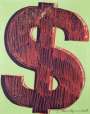
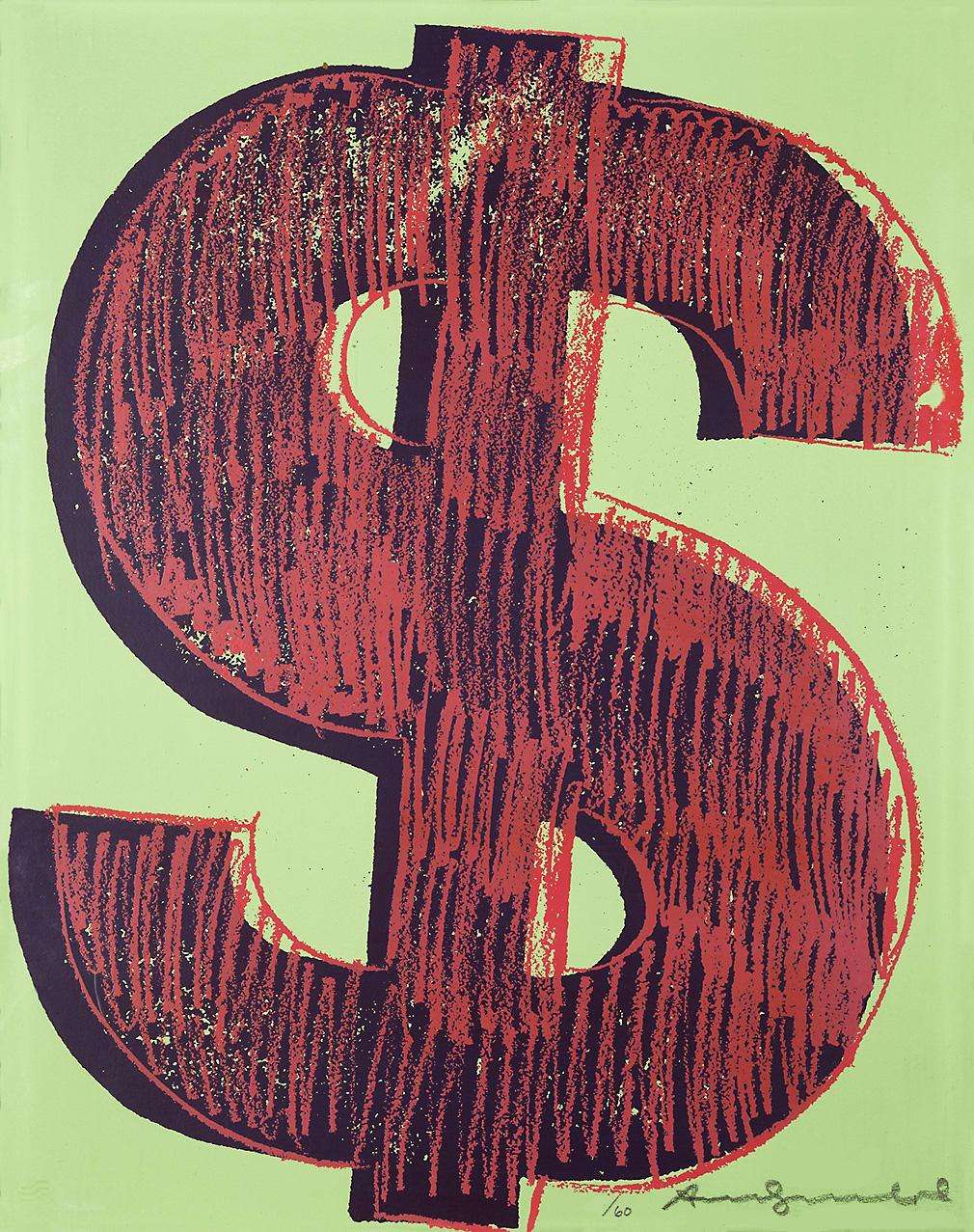
Dollar (F. & S. II.274) is a screenprint made in 1984. It depicts a single large dollar sign filling the vertical composition almost entirely, rendered in deep purple with dense red gestural hatching and flecks of gold against a bright lime green ground. Signed and numbered from an edition of 60 — one of the most restricted print editions of Warhol's late career.
The Dollar Sign series belongs to a late phase of Warhol's practice in which he turned his attention explicitly to money as image — the sign standing for the thing, as it always does, but examined here also as a formal object with its own visual properties. The dollar sign is among the most universally recognised graphic symbols in the world, and Warhol treated it with the same flat attention he brought to Brillo boxes or Campbell's cans in the early 1960s.
This print's particular chromatic configuration is among the most forceful in the series. The lime green ground — acid and almost hallucinatory — drives the purple-and-red dollar sign into maximum chromatic contrast. The symbol itself is heavily worked: deep purple providing the structural form, red hatching layered over it in dense vertical strokes, gold flecks breaking through at intervals. The overall surface is closer to a painting in its physical presence than to the flat graphic clarity of much of Warhol's screenprint output.
The edition of 60 makes Dollar (F. & S. II.274) one of the rarer prints of his final decade. The irony of scarcity applied to an image of the world's most liquid symbol of abundance is entirely consistent with Warhol's understanding of how the market and the image use each other.